Two Prices on Every Screen
1 Read
Read the class below, including each diagram, then tick the box.
This course is free to read. Sign in to tick off each class, take the quizzes and earn the certificate.
Next time you are at an airport, look at the currency booth. Its board shows two prices for every currency. That board is the best lesson in trading prices there is.
New words in this class: bid, ask and spread.
The money booth
Say you are flying to Paris. The booth’s board says:
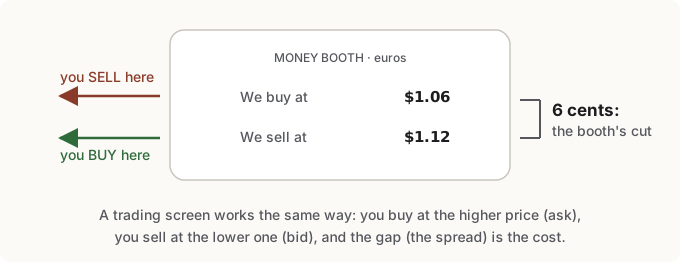
- You buy euros from the booth, so you pay its higher price: $1.12 for each euro.
- When you come home and sell your leftover euros back, you get its lower price: $1.06.
- The booth keeps the 6 cents in between. That is how it gets paid for being there whenever you need it.
The booth never loses on the gap: it buys low from one traveller and sells high to the next.
A trading screen is the same booth
A trading screen does exactly the same thing, just with smaller gaps and many more decimal places:
| On the screen | Booth words | When you get it |
|---|---|---|
| Bid 1.08450 | “We buy at” | When you sell |
| Ask 1.08462 | “We sell at” | When you buy |
- The bid is the price you get when you sell.
- The ask is the price you pay when you buy. It is always a little higher than the bid.
- The gap between them is the spread. Here it is 1.08462 − 1.08450 = 0.00012.
The spread is a small cost on every trade
Because you buy at the higher price and sell at the lower one, every trade starts a tiny bit behind. If you bought and sold again one second later, without the price moving at all, you would lose the spread.
That is normal, and it is small, but it is real. It is why traders prefer markets and times of day when the spread is narrow. You will learn exactly how to count it in Forex Essentials.
A memory trick: you always buy at the higher price and sell at the lower one. The market is the booth, and the booth always gets its cut.
This practice game needs JavaScript turned on.
Remember
- Every screen shows two prices: the bid (you sell) and the ask (you buy).
- The ask is higher than the bid. The gap is the spread.
- The spread is the small cost of every trade, like the booth’s cut.
2 Check yourself
4 questions. Pass mark 70%. Retake as often as you like; your best score counts.