Floors and Ceilings
1 Read
Read the class below, including each diagram, then tick the box.
This course is free to read. Sign in to tick off each class, take the quizzes and earn the certificate.
Watch any chart for long enough and you’ll notice something: price keeps stopping at the same places. It falls to a price and bounces, again and again. It rises to a price and turns back, again and again. Those places are the floors and ceilings of the market.
New words in this class: support, resistance and breakout.
Floors and ceilings
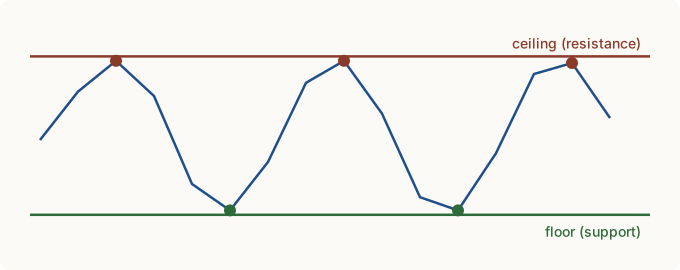
- A floor is a price where falling prices keep stopping and turning up. Traders call it support: it supports the price from below.
- A ceiling is a price where rising prices keep stopping and turning down. Traders call it resistance: it resists the price going higher.
The more times price has turned at a level, the more people notice it, and the more it matters.
Why do they work?
Remember class 1: price is people. When price bounced at a level before, people remember. Buyers who missed the last bounce wait there to buy. Sellers who sold at a ceiling wait to sell there again. Their waiting orders are what make price turn.
So a floor is really a crowd of buyers waiting at a price, and a ceiling is a crowd of sellers.
When a level breaks
Floors and ceilings aren’t walls. Sometimes there are more sellers than the floor’s buyers can handle, and price falls straight through. When price breaks through a level and keeps going, traders call it a breakout.
And here’s the clever part: a broken level often changes sides.
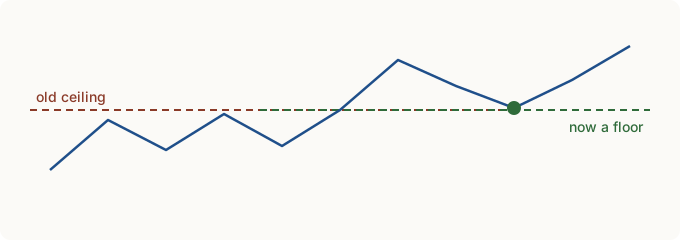
A ceiling that price breaks up through often becomes a floor on the way back down. The sellers who waited there are gone, and the buyers who missed the breakout are now waiting there instead.
Bigger boxes, stronger levels
Remember from class 3 that bigger candles tell bigger stories? The same goes for levels. A floor that held for a whole month matters much more than one that held for an hour. That idea, that the bigger the period the stronger the level, is the heart of The Outer Box method you’ll meet later.
This practice game needs JavaScript turned on.
Remember
- Support is a floor where price keeps turning up; resistance is a ceiling where it keeps turning down.
- They work because people wait to buy and sell at prices that mattered before.
- A breakout is price pushing through; a broken ceiling often becomes a floor.
2 Check yourself
4 questions. Pass mark 70%. Retake as often as you like; your best score counts.