Zoom In, Zoom Out
1 Read
Read the class below, including each diagram, then tick the box.
This course is free to read. Sign in to tick off each class, take the quizzes and earn the certificate.
Here’s something that confuses almost every beginner: you look at a chart and it’s clearly going down. A friend looks at the same market and says it’s going up. You can both be right.
New words in this class: timeframe.
Every candle covers a slice of time
Back in class 3 you saw six one-hour candles squeezed into one bigger candle. A candle can cover any slice of time you choose: one minute, one hour, one day, one week. That slice is the chart’s timeframe.
- On an hourly chart, each candle is one hour.
- On a daily chart, each candle is one day.
- On a weekly chart, each candle is one week.
Changing the timeframe is like zooming a map. Zoom in and you see every street; zoom out and you see the whole country. Same place, different view.
Two views, both true
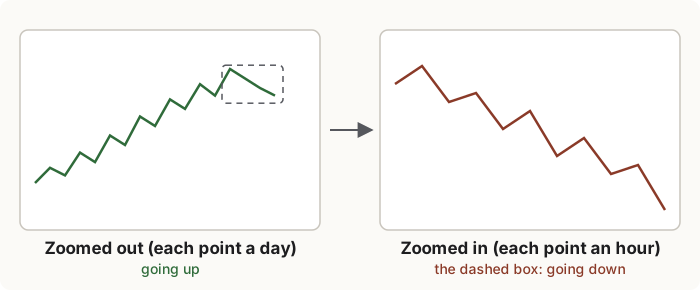
Zoomed out, this market is climbing. Zoomed in on the last few days, it’s going down. That down move is just a dip in the bigger climb, like walking downhill for a minute on a mountain path that keeps going up.
So when someone says “it’s going up”, the honest answer is: on which timeframe?
A simple habit: start big
- Start zoomed out (daily or weekly). That’s the big picture: up, down or sideways?
- Then zoom in (hourly) to see what’s happening right now.
- If the close-up goes against the big picture, it’s often just a dip or a bounce inside it.
Most traders give the bigger picture more weight, because it is built from more buying and selling. That idea, that the bigger box sets the bias for the smaller ones, is at the heart of the Outer Box method, and you’ll meet it properly later on your path.
This practice game needs JavaScript turned on.
Remember
- A chart’s timeframe is how much time each candle covers.
- Zooming in and out shows the same market at different sizes.
- A market can go down on the hourly chart and up on the daily chart at the same time.
- Start zoomed out, then zoom in.
2 Check yourself
4 questions. Pass mark 70%. Retake as often as you like; your best score counts.