Reading a Quote: Bid, Ask and the Spread
1 Read
Read the class below, including each diagram, then tick the box.
This course is free to read. Sign in to tick off each class, take the quizzes and earn the certificate.
Remember the money booth from First Steps? A forex screen is the same booth with more decimal places. This class turns that picture into real numbers you’ll see on your broker’s screen.
New words in this class: majors, crosses and exotics (three kinds of currency pair).
Two prices, not one
When you look up EUR/USD, a broker shows you two prices side by side:
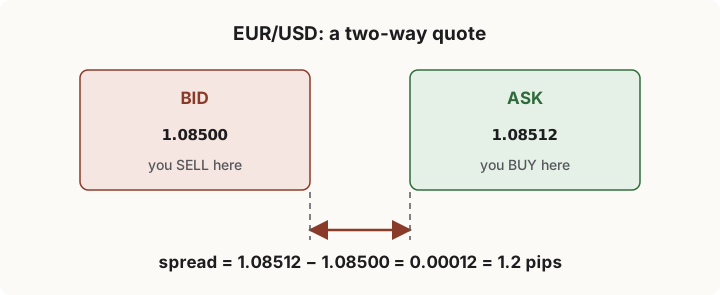
- The bid is the price the market will pay you if you sell.
- The ask (also called the offer) is the price you pay if you buy.
- The ask is always a little higher than the bid. The gap is the spread.
A simple way to remember it: the market buys from you at the low price and sells to you at the high one. That gap is how dealers and brokers are paid for being ready to trade with you at any moment.
The spread is a cost you pay on every trade
Suppose you buy EUR/USD and then, a second later, change your mind and close the trade. You bought at the ask, 1.08512, but you can only sell at the bid, 1.08500. You lose the spread, 1.2 pips, even though the price did not move.
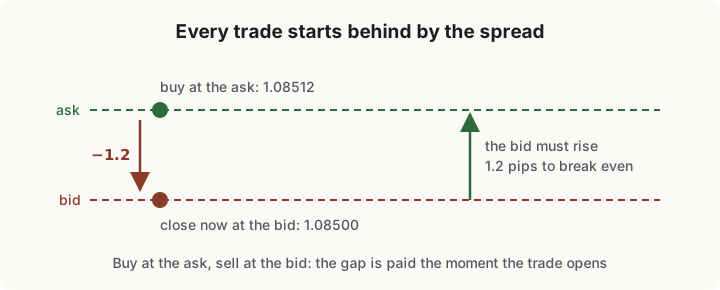
So every trade starts behind by the spread. A buy only breaks even once the bid rises to where you bought. A sell only breaks even once the ask falls to where you sold.
Measure the spread in pips: subtract the bid from the ask and divide by the pip size.
| Quote | Ask − Bid | Pip size | Spread |
|---|---|---|---|
| EUR/USD 1.08500 / 1.08512 | 0.00012 | 0.0001 | 1.2 pips |
| USD/JPY 150.230 / 150.248 | 0.018 | 0.01 | 1.8 pips |
| GBP/JPY 190.100 / 190.160 | 0.060 | 0.01 | 6 pips |
The fifth decimal place (or third on yen pairs) is a fractional pip, sometimes called a pipette: one tenth of a pip. Most brokers quote it so spreads can be shown as 1.2 pips instead of rounding to 1 or 2.
Which pairs cost the least to trade
Spreads are smallest where the most trading happens.
- Majors pair the US dollar with another large currency: EUR/USD, USD/JPY, GBP/USD, USD/CHF, AUD/USD, USD/CAD and NZD/USD. They usually have the tightest spreads, often around one pip or less in busy hours.
- Crosses (or minors) pair two major currencies without the dollar, such as EUR/GBP, EUR/JPY or GBP/JPY. Spreads are usually wider.
- Exotics pair a major currency with a smaller economy’s currency, such as USD/TRY or USD/ZAR. Spreads can be many times wider, and moves can be sudden.
A beginner who wants the lowest trading cost and the most predictable behaviour usually starts with the majors.
When the spread widens
A spread is not fixed. It widens whenever fewer participants are trading, or when everyone is waiting for news:
- Quiet hours. Around 5 PM Eastern, when New York closes and before Asia is busy, spreads often widen for an hour or so.
- Big news. In the seconds around major releases, such as the US jobs report or a central bank decision, spreads can jump to several times their usual size.
- The weekly open. When the market reopens on Sunday evening, liquidity is thin and spreads are wide for a while.
A trade that is fine at 10 AM can cost three times as much to enter at 5 PM. Check the spread before you place an order, not after.
Going deeper Which price is on your chart
Most charting platforms draw candles from the bid price. On thinkorswim, for example, the chart title says (BID). Two things follow:
- A sell stop (for a buy you hold) triggers on the bid, so it matches the chart.
- A buy stop or a buy limit triggers on the ask, which is above the chart by the spread. A buy order can fill even though the candle on your chart never quite touched your price, and a short’s stop can be hit when the bid candle stops a little short of it.
When you place a stop or target near an Outer Box level, remember the spread sits between what you see and what fills.
Remember
- You buy at the ask and sell at the bid; the gap is the spread.
- Spread in pips = (ask − bid) ÷ pip size, so 1.08512 − 1.08500 = 1.2 pips.
- Busy pairs (the majors) in busy hours cost least; spreads widen in quiet hours and around big news.
2 Check yourself
6 questions. Pass mark 70%. Retake as often as you like; your best score counts.