What a Pip Is Worth on Any Pair
1 Read
Read the class below, including each diagram, then tick the box.
This course is free to read. Sign in to tick off each class, take the quizzes and earn the certificate.
The chart counts in pips. Your account counts in dollars. This class is the bridge between the two, and it only needs one multiplication.
New words in this class: lot (a trade size) and pip value (what one pip is worth in money).
Units and lots, one more time
A position’s size is the number of units of the base currency (the first one in the pair) you buy or sell.
| Name | Units | Lots |
|---|---|---|
| Standard lot | 100,000 | 1.00 |
| Mini lot | 10,000 | 0.10 |
| Micro lot | 1,000 | 0.01 |
Some platforms ask for lots (0.07), others for units (7,000). They are the same trade. On thinkorswim, for example, the forex order ticket takes the quantity in units.
The one formula
The value of one pip, in the quote currency (the second one), is always:
pip value = pip size × units
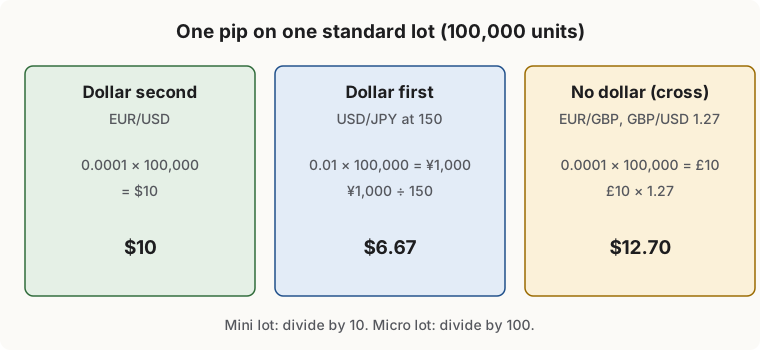
For 100,000 EUR/USD: 0.0001 × 100,000 = 10 US dollars. The quote currency is the dollar, so that is already the answer for a dollar account.
When the quote currency is not the dollar, there is one more step: convert that amount into dollars at today’s rate.
Three kinds of pair
1. The dollar is second (EUR/USD, GBP/USD, AUD/USD, NZD/USD). One pip on a standard lot is $10, at any price. A mini lot is $1, a micro lot $0.10.
2. The dollar is first (USD/JPY, USD/CAD, USD/CHF). The pip is worth a fixed amount of the other currency, so divide by the price to get dollars.
- USD/JPY at 150.00: 0.01 × 100,000 = 1,000 yen per pip. 1,000 ÷ 150 = $6.67.
- USD/CAD at 1.3600: 0.0001 × 100,000 = 10 Canadian dollars. 10 ÷ 1.36 = $7.35.
The dollar value drifts a little as the price moves, which is why your broker’s figure changes slightly from day to day.
3. No dollar at all: crosses (EUR/GBP, EUR/JPY, GBP/JPY). Work out the pip value in the quote currency, then convert it with that currency’s dollar rate.
- EUR/GBP: 0.0001 × 100,000 = 10 pounds per pip. With GBP/USD at 1.2700, that is 10 × 1.27 = $12.70.
- EUR/JPY: 1,000 yen per pip. With USD/JPY at 150.00, that is 1,000 ÷ 150 = $6.67.
You do not have to do this by hand every time. Your broker shows the pip value, and the site’s Pip Planner works it out for members. But you should be able to check it, because a wrong pip value means every size you calculate is wrong.
From pips to dollars
Once you know the pip value, every profit and loss is one multiplication:
profit or loss = pips × pip value per lot × lots
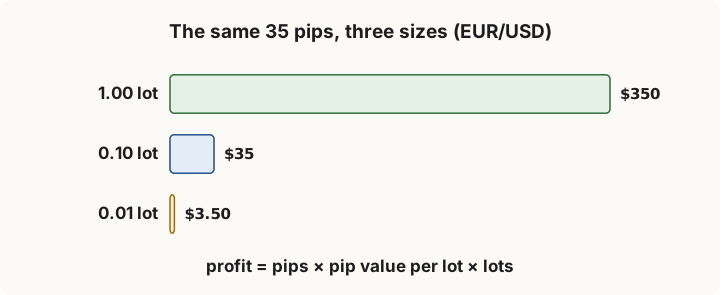
- 35 pips on 1 standard lot of EUR/USD: 35 × $10 × 1 = $350.
- The same 35 pips on 0.07 lots: 35 × $10 × 0.07 = $24.50.
- 35 pips on 0.5 lots of USD/JPY at 150: 35 × $6.67 × 0.5 = about $117.
The chart only tells you pips. Your size turns them into dollars. Two traders can take the same trade on the same chart and have results ten times apart, because one traded ten times as many units. That is why the next course, Risk and Money Management, starts with size rather than with entries.
Going deeper Pips on the Outer Box ladder
Every ladder level is a price, so the distance between two levels is a number of pips, and the pip value turns it into money. On a monthly EUR/USD box with R1 at 1.1200 and S1 at 1.0800, the range is 400 pips:
- From S1 to C is 200 pips.
- From the 10% level to C is 160 pips.
- From the 90% level to R1 is 40 pips.
Before a trade, you can read off exactly how many pips lie between your entry, your stop and your target, and then size the trade so the stop distance costs only what you can afford. That is the subject of the next course.
Remember
- Trade size is counted in lots: 1 standard = 100,000 units, 0.1 = mini, 0.01 = micro.
- Pip value = pip size × units. On pairs ending in USD, one standard lot is $10 a pip.
- Profit or loss = pips × pip value per lot × lots. The chart gives the pips; your size gives the dollars.
2 Check yourself
6 questions. Pass mark 70%. Retake as often as you like; your best score counts.