Leverage and Margin, in Numbers
1 Read
Read the class below, including each diagram, then tick the box.
This course is free to read. Sign in to tick off each class, take the quizzes and earn the certificate.
In Market Basics, leverage was a magnifying glass. Here are the actual numbers on your account screen, and the one mistake that ends more beginner accounts than any other.
New words in this class: margin (the deposit a trade locks up), free margin (what’s left over) and margin call.
Margin is a deposit, not a fee
When you open a forex position, the broker sets aside part of your account as a good-faith deposit. That is the margin. It is not spent; you get it back when the position closes. But while the position is open, it is locked.
margin required = position value ÷ leverage
The position value (also called the notional value) is the units times the price, in dollars.
- 10,000 EUR/USD at 1.1000 is worth 10,000 × 1.10 = $11,000.
- At 50:1, the margin is 11,000 ÷ 50 = $220. That is a 2% deposit.
In the United States, retail forex leverage is capped at 50:1 on the major pairs (a 2% deposit) and 20:1 on the others (a 5% deposit). Brokers may ask for more, and often do before weekends and big news.
Equity, used margin and free margin
Three numbers on your account screen matter more than any other:
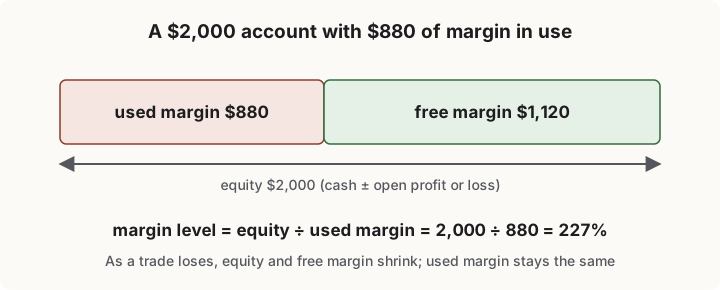
- Equity: your cash plus or minus the profit or loss on open trades. It moves with every tick.
- Used margin: the deposits locked by your open positions.
- Free margin: equity minus used margin. This is what is left to absorb losses and open new trades.
Many platforms also show a margin level: equity ÷ used margin, as a percentage. In the example, $2,000 ÷ $880 = 227%.
As a trade loses, equity falls, but the margin stays the same. Free margin shrinks, and the margin level falls toward 100%.
What happens when margin runs out
When your equity falls to a level the broker sets, usually somewhere around the used margin itself, the broker issues a margin call or simply closes your positions automatically, starting with the largest losers. Every broker sets its own levels, so look up yours before you trade. You do not get to wait for the price to come back.
Here is how quickly that can happen:
- Account: $2,000.
- Position: 0.80 lots of EUR/USD at 1.1000, worth $88,000. Margin at 50:1: $1,760.
- Free margin: $2,000 − $1,760 = $240.
- Each pip is worth $10 × 0.80 = $8.
- $240 ÷ $8 = 30 pips. If the broker closes positions when equity reaches the used margin, a 30-pip move against you, an ordinary hour on EUR/USD, ends the trade.
The margin, not the chart, decided where this trade stopped. That is the most common way new forex traders lose an account: a position so large that normal noise reaches the margin limit before the trade idea has had a chance.
Effective leverage: the number that matters
The 50:1 cap tells you the most you are allowed to use. Effective leverage tells you how much you are using:
effective leverage = total position value ÷ equity
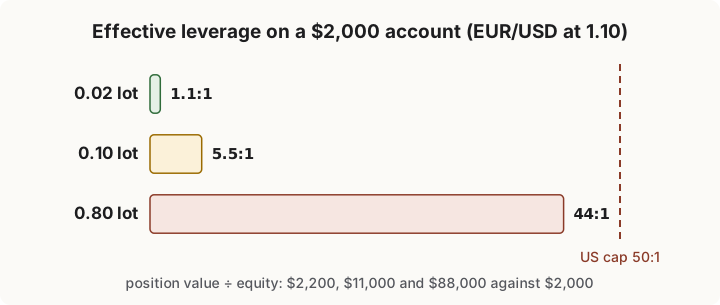
In the example above, $88,000 ÷ $2,000 = 44:1. A 1% move in EUR/USD (about 110 pips) would change the account by 44%.
At 5:1, the same 1% move changes the account by 5%. Many experienced traders keep their effective leverage low, often in single figures, for exactly this reason. The cap is a limit, not a target.
Going deeper Margin and the Outer Box stop
The book places stops beyond the threshold (for example, beyond the −10% level for a long at S1), which is wider than a stop just under the low. A wider stop needs a smaller position for the same dollar risk, and a smaller position uses less margin. Sized that way, a trade will be stopped where the reading is wrong, long before the margin limit is near.
If your free margin would run out before your stop is reached, the position is too large. Shrink it until the stop comes first.
Remember
- Margin is a deposit, not a fee: position value ÷ leverage.
- Free margin is your cushion. When it runs out, the broker closes your trades, whatever your stop says.
- The leverage limit is a ceiling, not a target: keep the leverage you actually use low.
2 Check yourself
6 questions. Pass mark 70%. Retake as often as you like; your best score counts.