Sessions, Orders and Rollover
1 Read
Read the class below, including each diagram, then tick the box.
This course is free to read. Sign in to tick off each class, take the quizzes and earn the certificate.
You know which price you get and what it’s worth. Now: how to actually tell your broker what you want, and how to protect a trade before you even start it.
New words in this class: limit order, stop order and stop-loss.
The four basic orders
A market order fills at once at the current price: the ask if you buy, the bid if you sell. It is the only order that is certain to fill, but not at an exact price.
Every other order waits for a price. Which one you use depends on two questions: are you buying or selling, and is your price better than now (a pullback) or worse than now (a breakout)?
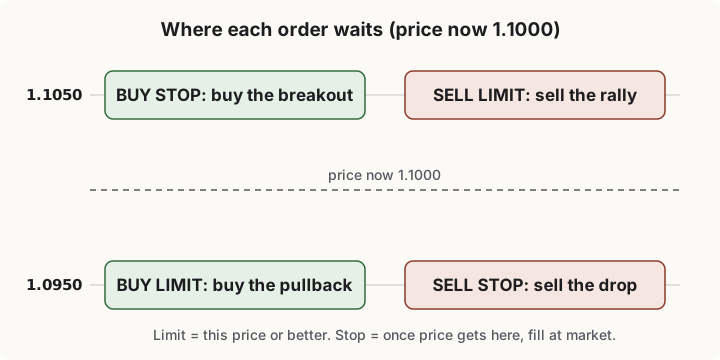
| Order | Sits | Fills when price | Typical use |
|---|---|---|---|
| Buy limit | below the price | falls to it | Buy a pullback to support |
| Buy stop | above the price | rises to it | Buy a breakout; close a short at its stop |
| Sell limit | above the price | rises to it | Sell a rally into resistance; take profit on a long |
| Sell stop | below the price | falls to it | Sell a breakdown; close a long at its stop |
A limit order says “this price or better”. A stop order says “once price gets here, get me in (or out) at the market”. A stop can slip: in a fast market it fills at the next available price, which may be worse than the stop.
Protecting a trade: the bracket
Most platforms let you attach two exit orders to a trade as soon as it fills:
- a stop loss (a stop order) on the losing side, and
- a take profit (a limit order) on the winning side.
They are linked as one cancels the other (OCO): when one fills, the other is cancelled. Together they are often called a bracket. With a bracket in place, the trade’s worst and best outcomes are decided before it starts, and nothing depends on you watching the screen.
In Outer Box terms, both orders are levels on the ladder: the stop beyond the threshold that proves the reading wrong, and the target at the next level, usually C or the edge zone.
The trading week
The forex week runs from about 5 PM Eastern on Sunday to 5 PM Eastern on Friday.
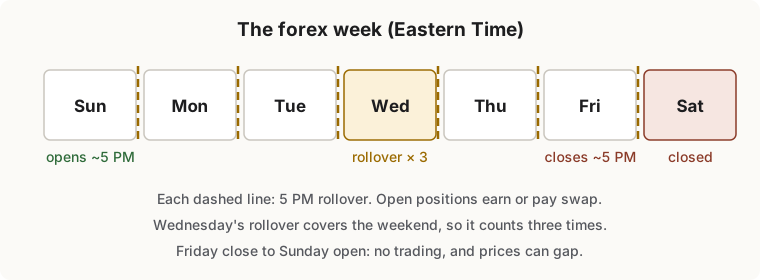
Rollover. A position still open at 5 PM Eastern is rolled over to the next day. You are paid or charged a small amount called swap (or rollover interest). It depends on the interest-rate difference between the two currencies, and on whether you are long or short. Holding the higher-rate currency usually earns a little; holding the lower-rate one costs a little, and brokers add their own markup.
Wednesday counts three times. Spot forex settles two business days after the trade, so the rollover on Wednesday covers Saturday and Sunday too, and is usually three times the normal amount.
Weekend gaps. The market is closed from Friday evening to Sunday evening, but the world is not. If something big happens over the weekend, Sunday’s first price can be far from Friday’s last. A stop cannot fill inside that gap; it fills at the first available price. This is one reason many brokers raise margin before weekends, and why many short-term traders close positions on Friday.
Going deeper Sessions and the daily box
Market Basics showed the four sessions: Sydney, Tokyo, London and New York, with the busiest hours when London and New York overlap, about 8 AM to noon Eastern.
For the Outer Box, two facts about the day matter:
- The daily candle closes at 5 PM Eastern on most forex platforms. That is when yesterday’s box becomes complete, and when the daily ladder for the new day is set.
- The day’s range is often set in the busy hours. Quiet Asian hours tend to move less; the London open and the overlap often decide the day’s high or low. A daily box built from a holiday or a quiet day is narrow, and its levels are close together.
News that moves currencies
Some scheduled releases move the major pairs more than anything else:
- Central bank decisions: the US Federal Reserve (FOMC), the European Central Bank, the Bank of England, the Bank of Japan. Interest rates drive currencies more than anything.
- US employment (the jobs report, usually the first Friday of the month at 8:30 AM Eastern).
- Inflation (CPI) and growth (GDP) figures.
Around these releases, spreads widen, prices jump and stops can slip. Most economic calendars mark each release by expected impact. Know when the big ones are before you open a trade, and decide in advance whether you will hold through them.
Remember
- A limit order waits for a better price; a stop order waits for price to reach a level, then fills at the market.
- Attach a stop-loss and a target to every trade, so the worst and best outcomes are decided before it starts.
- Holding past 5 PM Eastern earns or costs a little interest; weekends can gap; big scheduled news widens spreads.
2 Check yourself
6 questions. Pass mark 70%. Retake as often as you like; your best score counts.