How Much to Risk on One Trade
1 Read
Read the class below, including each diagram, then tick the box.
This course is free to read. Sign in to tick off each class, take the quizzes and earn the certificate.
This might be the most important class on the whole site. Good traders lose all the time; what keeps them in the game is that each loss is small. Here’s how.
New words in this class: risk (what you lose if your stop is hit) and drawdown (how far the account falls from its high).
Risk means the loss if the stop is hit
In this course, risk has one meaning: the amount you lose if the trade reaches its stop. Not the size of the position, not the margin, but the loss on the planned exit.
risk = stop distance in pips × pip value per lot × lots
A trade with no stop has no defined risk, which in practice means the whole account is at risk. Every trade in this course has a stop before it is opened.
Risk a fixed fraction, not a fixed amount
A widely used rule is to risk a fixed percentage of the account on each trade, often between 0.5% and 2%.
- On a $5,000 account at 1%, each trade risks $50.
- After a loss, the account is $4,950, and the next trade risks $49.50.
- After a win that takes it to $5,200, the next trade risks $52.
Risk shrinks automatically when you are losing and grows when you are winning. That one property keeps a bad run from turning into a disaster.
What a losing streak does
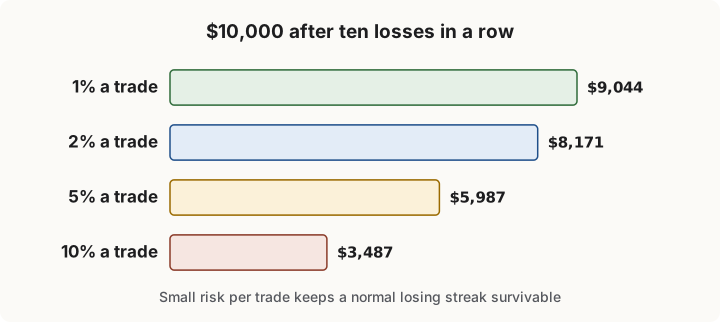
Every method has losing streaks. In the last class of the Trading Psychology course you will see how often they happen; for now, assume ten losses in a row will happen to you one day.
| Risk per trade | After 10 straight losses | Account lost |
|---|---|---|
| 1% | $9,044 | about 10% |
| 2% | $8,171 | about 18% |
| 5% | $5,987 | about 40% |
| 10% | $3,487 | about 65% |
At 1%, ten losses are an unpleasant month. At 10%, they are the end of the account for most people, not because the method failed, but because the size did.
Getting back is harder than falling
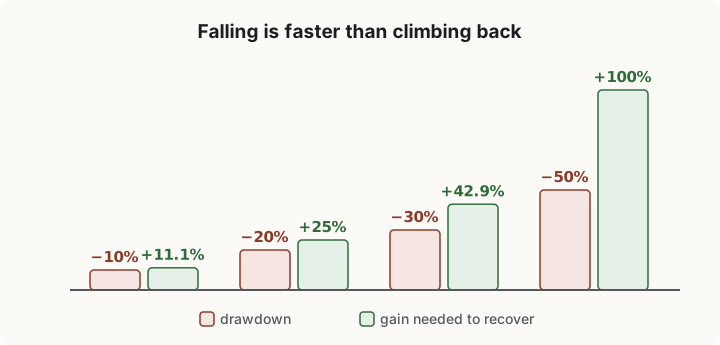
A loss and the gain needed to recover from it are not the same size, because the gain is measured on a smaller balance.
| Drawdown | Gain needed to get back |
|---|---|
| 10% | 11% |
| 20% | 25% |
| 30% | 43% |
| 50% | 100% |
A 50% drawdown needs the account to double just to get back to where it started. Small risk per trade keeps drawdowns in the range where recovery is realistic.
Choosing your number
There is no single correct percentage. A few points to weigh:
- Smaller is safer while you learn. Many educators suggest 0.5% to 1% until you have a long record of trades with the method.
- Your stop decides your size, not the other way round. Choosing 1% does not mean a tighter stop; it means a smaller position. The next class shows how.
- Very small accounts hit the minimum size. On a $1,000 account, 1% is $10. If the stop is 100 pips, even the smallest common size (0.01 lots, $0.10 a pip) risks $10. Any wider stop is more than 1%, and the honest answer is to skip that trade or use a smaller box.
- Write the number down and do not change it in the middle of a losing streak. That is when the temptation is strongest and the decision is worst.
Going deeper Total risk, not just one trade
If you have three trades open, each risking 1%, your total open risk is 3%. And if those three trades are all bets on the same thing, such as three pairs that all rise when the dollar falls, they can all lose together. Class 4 covers how to cap total risk.
Remember
- Risk is the loss if the stop is hit, decided before the trade.
- Risk a small, fixed percentage of the account on each trade, often 0.5% to 2%.
- Losing streaks happen to everyone; small risk keeps a drawdown small enough to recover from.
2 Check yourself
6 questions. Pass mark 70%. Retake as often as you like; your best score counts.