Sizing a Position from Its Stop
1 Read
Read the class below, including each diagram, then tick the box.
This course is free to read. Sign in to tick off each class, take the quizzes and earn the certificate.
You’ve decided how much you’re willing to lose on a trade. Now the fun bit: one short formula tells you exactly how big the trade should be.
New words in this class: position size (how big the trade is).
Three numbers in, one number out
Position sizing answers one question: how many lots can I trade so that, if the stop is hit, I lose exactly my risk amount?
You need three numbers:
- Risk amount in dollars (your percentage of the account).
- Stop distance in pips (from your entry to your stop).
- Pip value for one standard lot of that pair (Forex Essentials, class 2).
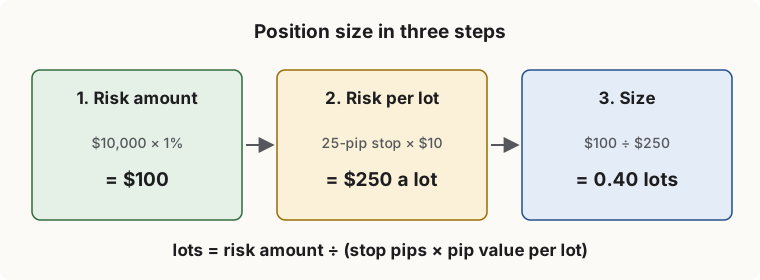
lots = risk amount ÷ (stop pips × pip value per lot)
Worked examples
A $10,000 account, 1% risk, EUR/USD, 25-pip stop. Risk $100. One lot loses 25 × $10 = $250. Size: 100 ÷ 250 = 0.40 lots (40,000 units).
A $1,500 account, 1% risk, EUR/USD, 20-pip stop. Risk $15. One lot loses 20 × $10 = $200. Size: 15 ÷ 200 = 0.075, rounded down to 0.07 lots (7,000 units). The actual risk is 20 × $10 × 0.07 = $14.
A $1,500 account, 1% risk, USD/JPY at 150, 30-pip stop. Pip value $6.67. One lot loses 30 × $6.67 = $200. Size: 15 ÷ 200 = 0.075, rounded down to 0.07 lots.
Always round down. Rounding up means risking more than your rule.
Same risk, different stops
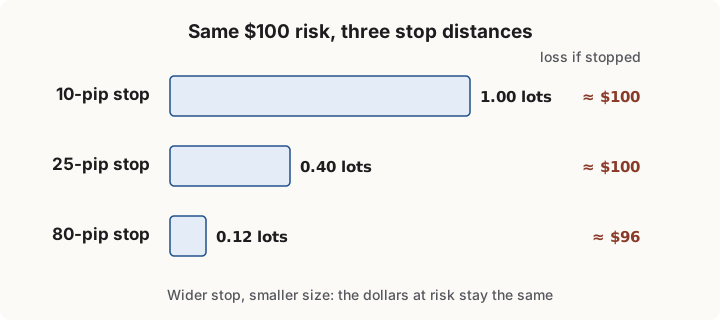
The rule keeps the dollars fixed and lets the size move with the stop:
| Stop | Size | Loss if stopped |
|---|---|---|
| 10 pips | 1.00 lot | $100 |
| 25 pips | 0.40 lots | $100 |
| 80 pips | 0.12 lots | $96 |
A wide stop is not more dangerous than a narrow one. A wide stop with the same size as a narrow one is.
Going deeper Where the stop distance comes from
The size formula needs a stop distance, and the stop has to come from somewhere other than “what fits”. Two common sources:
- The ladder (the Outer Box method). The stop goes beyond the level that would prove the trade wrong: for a long bought on a bounce from S1, beyond the −10% level, not just under S1. Class 3 covers this.
- Volatility (ATR). The Average True Range is the average size of recent bars. A stop at 2 or 3 times ATR sits outside normal noise. On a 15-minute EUR/USD chart, an ATR of 7 pips gives a 3 × ATR stop of about 21 pips; on a daily chart, an ATR of 70 pips gives 210.
Both give a distance that the market decides. Your sizing then makes that distance affordable.
When the trade is too big
Sometimes the formula gives a size below the smallest your broker allows (often 0.01 lots, or 1,000 units).
Example. $1,500 account, 1% = $15. A monthly EUR/USD box of 400 pips: a long entered at the 10% level with a stop beyond −10% is 80 pips away. One lot loses 80 × $10 = $800. Size: 15 ÷ 800 = 0.019, rounded down to 0.01 lots, which risks $8. That fits. But a 200-pip daily ATR stop would need 15 ÷ 2,000 = 0.0075 lots, which is below the minimum.
The honest choices are:
- Skip the trade. There will be another.
- Use a smaller box. Take the same reading on a lower timeframe, where the levels and stops are closer together.
- Accept a larger risk on purpose, knowing the trade is outside your rule. This is the one to be most wary of.
The choice you should never make is to keep the size and pull the stop closer, so that it sits where the reading has not failed. That turns a sound trade into one that loses to normal noise.
Tools that do the arithmetic
You should be able to do this by hand, but you do not have to every time. Most platforms have a position-size field or calculator, the site’s Pip Planner (for members) works out the size from your risk and the ladder, and the OuterBox TrendTrader indicator shows the suggested size for your account in its PositionSizing panel. Check any tool against the formula once, so you know it is set up for your account.
Remember
- Lots = risk amount ÷ (stop pips × pip value per lot). Round down, never up.
- A wider stop means a smaller position; the money at risk stays the same.
- If even the smallest size risks too much, skip the trade. There will be another.
2 Check yourself
6 questions. Pass mark 70%. Retake as often as you like; your best score counts.