Stops, Targets and Expectancy on the Ladder
1 Read
Read the class below, including each diagram, then tick the box.
This course is free to read. Sign in to tick off each class, take the quizzes and earn the certificate.
A trade has three prices: where you get in, where you get out if you’re wrong, and where you get out if you’re right. On the Outer Box ladder, all three are levels you can see before you start.
New words in this class: reward-to-risk, win rate and expectancy.
Every part of the trade is a level
Chapter 21 of the book states one rule for turning a reading into a trade: every part of the trade is a level on the ladder. The entry, the stop and the target are all prices the ladder already names. That makes them easy to measure, and measurement is what risk management needs.
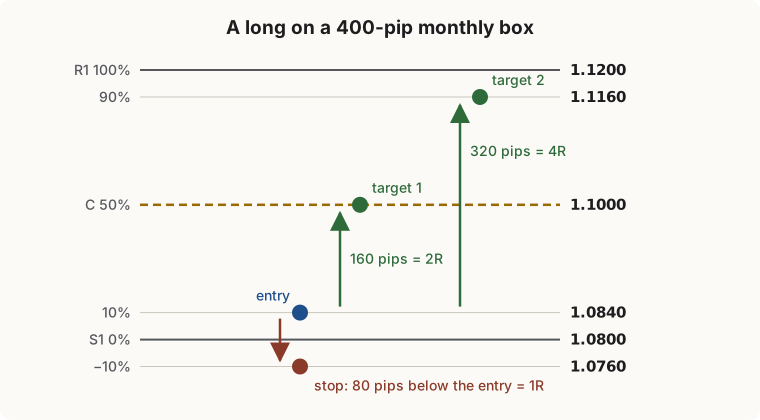
Entry. The sentiment trigger: price tests S1, then closes back above the 10% level (Chapter 10). Here, about 1.0840.
Stop. Beyond the threshold that would prove the reading wrong. A bounce from S1 is wrong once S1 is broken and confirmed below the −10% level (Chapter 12). The stop goes beyond −10%, at 1.0760: 80 pips from the entry. A stop a few pips under S1 would sit inside the zone where false breaks happen and where other traders’ stops cluster.
Target. The next level in the direction of the trade. First C, at 1.1000: 160 pips. Then the 90% edge zone, at 1.1160: 320 pips.
Measure the trade in R
Traders often measure a trade in R, where 1R is the amount risked. If you risk $50, a $100 win is +2R and a full stop-out is −1R.
reward-to-risk = target distance ÷ stop distance
In the ladder trade above:
- Target at C: 160 ÷ 80 = 2R.
- Target at the 90% level: 320 ÷ 80 = 4R.
Thinking in R lets you compare trades of any size, on any pair, on any account.
The break-even win rate
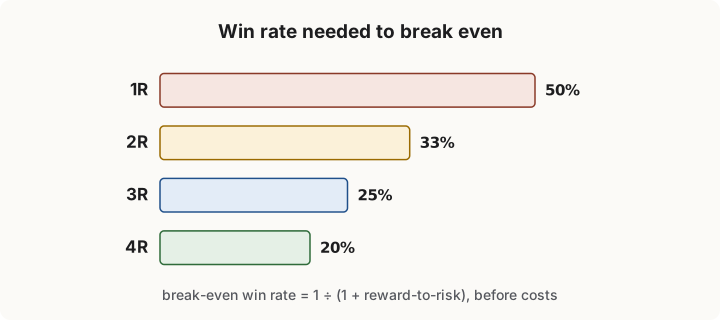
A trade’s reward-to-risk tells you how often it has to win just to break even:
break-even win rate = 1 ÷ (1 + reward-to-risk)
| Reward-to-risk | Must win at least |
|---|---|
| 1R | 50% |
| 2R | 33% |
| 3R | 25% |
| 4R | 20% |
A method that targets 2R can lose two trades in three and still not lose money (before costs). That is why a low win rate is not, on its own, a problem.
Expectancy: what a trade is worth on average
Win rate and reward-to-risk only mean something together. Expectancy combines them into the average result per trade, in R:
expectancy = (win rate × average win) − (loss rate × average loss)
| Method | Win rate | Average win | Average loss | Expectancy |
|---|---|---|---|---|
| A | 60% | 1R | 1R | 0.6 − 0.4 = +0.2R |
| B | 40% | 2R | 1R | 0.8 − 0.6 = +0.2R |
| C | 70% | 0.5R | 1R | 0.35 − 0.3 = +0.05R |
| D | 30% | 2R | 1R | 0.6 − 0.7 = −0.1R |
Method C wins most often and earns least. Method D looks fine on any single good day, and loses money over time. Always judge a method by its expectancy over many trades, never by its win rate alone. Spreads and slippage reduce every one of these numbers a little, so an expectancy near zero before costs is usually negative after them.
Going deeper Moving the stop as levels are crossed
Chapter 21 also says what to do as the trade moves:
- When price reclaims a level in your favour (for the long above, when it closes above C), move the stop up behind the last confirmed level, beyond its threshold. Above C, the stop can go beneath the 10% level instead of beneath −10%.
- At the first target, a common approach is to take part of the position off and let the rest run to the next level with the stop behind C.
- At the edge zone, reassess. Either the top of the box rejects price and you exit, or a failed rejection and confirmation at 110% open the way to R2.
- At the invalidation, exit. No averaging down, no widening the stop.
The stop only ever moves in the direction of the trade. A stop that moves further away to avoid a loss is no longer a stop.
Remember
- Measure trades in R: 1R is what you risked. A +2R win made twice the risk.
- The bigger the reward-to-risk, the less often you need to win to break even.
- Expectancy is what your rules make per trade on average; it only shows over many trades.
2 Check yourself
6 questions. Pass mark 70%. Retake as often as you like; your best score counts.