Your Written Trading Plan
1 Read
Read the class below, including each diagram, then tick the box.
This course is free to read. Sign in to tick off each class, take the quizzes and earn the certificate.
The best time to decide what to do in a trade is before you’re in one. This class helps you write your rules down while you’re calm, on one page.
New words in this class: trading plan (your rules in writing).
A plan is rules you set when you are calm
Every decision in this course is easier to make before a trade than during one. A trading plan is simply those decisions, written down while nothing is at stake, so that the moment a trade is open you are following rules rather than making them.
Chapter 21 of the book ends with the same point: the ladder sets entry, stop and target, but risk per trade, how many positions to hold and what to do when markets disagree are decisions about the account, and they belong to your own rules, written before the trade and not changed by it.
Size by alignment
The book gives one guide to how much of your risk to use on a trade: how many boxes agree.
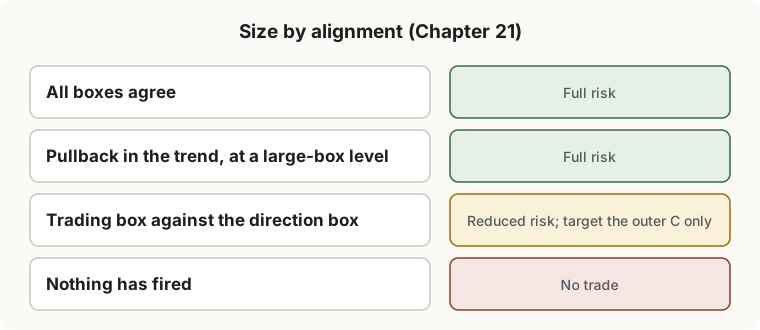
- All boxes aligned: full risk (for example, 1%).
- Pullback inside the trend, entered at a large-box level: full risk.
- Counter-trend trade (trading box against the direction box): reduced risk (for example, half), target the outer C and no further.
- Nothing has fired: no trade.
Cap your total risk
One trade at 1% is controlled. Five trades at 1% each, open at once, are 5% at risk.
- Set a maximum total open risk, for example 3% across all trades.
- Correlated pairs count together. EUR/USD, GBP/USD and AUD/USD often move in the same direction, because each is mostly a bet against the US dollar. Three longs in them are closer to one large trade than three small ones.
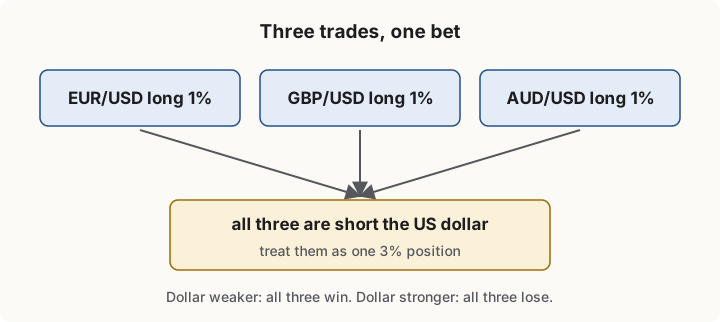
A simple rule: if two trades would win or lose for the same reason, count them as one when you apply your limits.
Daily and weekly stop rules
Losses cluster, and judgment gets worse after several losses in a row. Decide in advance when you stop for the day:
- Daily loss limit: for example, stop trading for the day after losing 2% or after three losing trades.
- Weekly loss limit: for example, after 5% down in a week, trade only the smallest size until the next week.
- Drawdown review: for example, after a 10% drawdown from your peak, stop and review your journal before the next trade.
These rules feel unnecessary on good days. They exist for the bad ones.
News and weekends
Decide in advance:
- whether you hold trades through high-impact news (central bank decisions, the US jobs report, inflation data), or close or avoid trading before them;
- whether you hold trades over the weekend, when a gap can jump past your stop.
Your one-page plan
Copy this and fill it in before your next trade. Keep it next to your screen.
| Section | Your rule |
|---|---|
| Account and risk | Risk per trade: % of equity. Smallest size I will trade: |
| Boxes | Direction box: ___ State box: ___ Trading box: ___ |
| Entry | I enter only on: ___ (for example, a sentiment trigger on the trading box in the direction box’s bias) |
| Stop | Placed: ___ (for example, beyond the −10% or 110% threshold) |
| Target | First: ___ Second: ___ (for example, C, then the edge zone) |
| Size | Full when ; reduced (%) when ; none when |
| Total risk | Maximum open risk: ___%. Correlated pairs count as one |
| Stop rules | Daily: ___ Weekly: ___ Review after a drawdown of ___% |
| News and weekends | ___ |
| Record | After every trade I write: the reading, the levels, the result in R, and whether I followed this plan |
The last row matters most. The Trading Psychology course shows how to use that record.
Remember
- A plan is rules you set while calm and follow while the market is moving.
- Cap your total risk and set a daily stop: a bad day stays a bad day, not a bad month.
- Write the one-page plan now, and check every trade against it.
2 Check yourself
6 questions. Pass mark 70%. Retake as often as you like; your best score counts.