What a Futures Contract Is
1 Read
Read the class below, including each diagram, then tick the box.
This course is free to read. Sign in to tick off each class, take the quizzes and earn the certificate.
What you will be able to do
- Explain what a futures contract obliges each side to do.
- Tell a futures contract from a private forward agreement, and say why the difference matters.
- Explain what the exchange and the clearinghouse each do.
- Describe how hedgers and speculators use the same contract.
- Explain how a futures profit or loss is paid, and who protects your account.
A promise with a date
A futures contract is an agreement to buy or sell a set amount of something, at a price agreed today, for delivery on a set future date.
- The buyer is long: they agree to take delivery and pay the agreed price. They gain if the price rises.
- The seller is short: they agree to deliver and receive the agreed price. They gain if the price falls.
Unlike an option (see Trading Options), there is no premium and no right to walk away. Both sides are obligated, and both sides carry the full risk of the price moving against them.
In practice, almost nobody who trades futures for speculation ever delivers or receives anything. They close the position before expiration by making the opposite trade: a long sells the same contract, a short buys it back. The profit or loss is the difference between the two prices. Class 4 explains how to stay clear of delivery.
From handshake to exchange
Agreements like this are as old as farming. A wheat farmer in March agrees with a miller to sell 5,000 bushels in September at today’s price: the farmer is protected if wheat falls, the miller if it rises. That private agreement is a forward contract. Forwards have two problems:
- Counterparty risk. If wheat collapses, the miller may simply refuse to pay the agreed price.
- No exit. Each forward is a custom deal. If the miller changes plans, finding someone to take over that exact agreement is hard.
Futures fix both problems by standardizing the contract and trading it on an exchange:
| Forward | Futures | |
|---|---|---|
| Terms | Negotiated each time | Standard: size, quality, date, place set by the exchange |
| Where | Privately, between two parties | On an exchange, anonymously |
| Counterparty | The other party | The clearinghouse |
| Exit before the date | Hard | Easy: make the opposite trade |
| Gains and losses | Paid at the end | Paid every day (Class 3) |
The exchange and the clearinghouse
The largest U.S. futures exchange group is CME Group, which runs four exchanges: the CME (stock indexes, currencies, interest rates), the CBOT (Treasury bonds, grains), NYMEX (energy) and COMEX (metals). Almost all electronic trading happens on its platform, CME Globex.
- The exchange writes the contract specifications, lists the contracts and matches buyers with sellers.
- The clearinghouse (CME Clearing) becomes the buyer to every seller and the seller to every buyer. Once your trade is matched, your contract is with the clearinghouse, not with the stranger who took the other side.
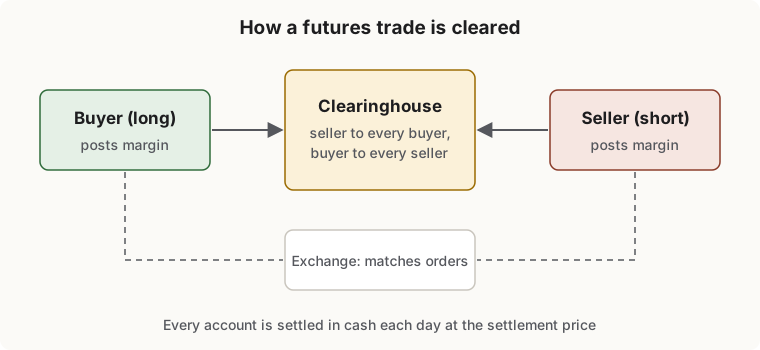
To make that guarantee safe, the clearinghouse collects a deposit from both sides (margin) and settles every account every day: winners are paid and losers pay, in cash, based on the day’s settlement price. Nobody is allowed to build up a large unpaid loss. Class 3 walks through this day by day.
Who trades futures
Hedgers use futures to reduce a risk they already have:
- An airline buys crude oil or jet fuel futures to lock in fuel costs.
- A gold miner sells gold futures to lock in the price of next year’s output.
- A pension fund sells stock index futures to protect a portfolio for a few weeks without selling the stocks.
- A U.S. company expecting a payment in euros sells euro futures to lock in the exchange rate.
Speculators take on price risk to profit from it: individual traders, hedge funds, trading firms. They supply the other side of the hedgers’ trades and much of the market’s liquidity. Most people taking this course are speculators. That is a legitimate role, but it means you are taking risk on purpose, so you must manage it on purpose.
Long and short are equal
In the stock market, selling short means borrowing shares and has extra rules. In futures, going short is exactly as easy as going long: you simply sell a contract you do not own. Every contract has one long and one short, so the total number of longs always equals the total number of shorts. The number of contracts open at any time is called open interest.
This makes futures a natural tool for trading both directions. A bearish reading on the S&P 500 is expressed by selling an index future, with no borrowing and no restrictions.
What you are really trading
A futures position is leveraged exposure to the price of the underlying. One E-mini S&P 500 contract (Class 2) at an index level of 6,000 controls $300,000 of the S&P 500, for a margin deposit that is a small fraction of that. A 1% move in the index is a $3,000 gain or loss on one contract.
That is the core fact of futures trading: small price moves are large amounts of money. Everything in this course, from tick values to sizing, is about knowing exactly how much money each move means before you trade.
Who regulates the market and protects your account
- The Commodity Futures Trading Commission (CFTC) is the U.S. federal regulator of futures markets.
- The National Futures Association (NFA) is the industry’s self-regulatory body. Every firm and professional that handles customer futures business must be registered with it. You can check a firm on the NFA’s BASIC database.
- Your broker for futures is a futures commission merchant (FCM) or works through one. FCMs must keep customer money in segregated accounts, separate from the firm’s own money.
- SIPC protection, which covers stock accounts, does not cover futures accounts. Your protection is segregation and the clearinghouse system. That is one reason to use a large, well-capitalized broker.
2 Check yourself
7 questions. Pass mark 70%. Retake as often as you like; your best score counts.