Contract Specifications
1 Read
Read the class below, including each diagram, then tick the box.
This course is free to read. Sign in to tick off each class, take the quizzes and earn the certificate.
What you will be able to do
- Read a contract’s specifications: size, quote, tick size, tick value, months, settlement.
- Work out the dollar value of any price move from ticks or points.
- Work out a contract’s notional value, the amount of the underlying it controls.
- Read futures symbols as the exchange and your platform write them.
The specification sheet
Every futures contract has a specification sheet published by the exchange (on CME Group’s site, the Contract Specs tab of each product). The lines that matter most to a trader:
| Line | Meaning | Example: E-mini S&P 500 |
|---|---|---|
| Contract unit | How much of the underlying one contract covers | $50 × the S&P 500 index |
| Price quotation | How the price is written | Index points, to two decimals |
| Minimum price fluctuation (tick) | The smallest step the price can move, and its dollar value | 0.25 points = $12.50 |
| Listed contracts | Which months trade | March, June, September, December |
| Settlement method | What happens at expiration | Cash-settled |
| Termination of trading | The last day | Third Friday of the contract month |
| Trading hours | When it trades | Nearly 23 hours a day, Sunday evening to Friday afternoon (Class 5) |
Ticks and points: the one formula
A tick is the minimum price step. The tick value is what one tick is worth on one contract. Every profit or loss is:
profit or loss = number of ticks × tick value × number of contracts
Some contracts are easier to think about in points (a move of 1.00 in the price). Then:
profit or loss = points × multiplier × contracts
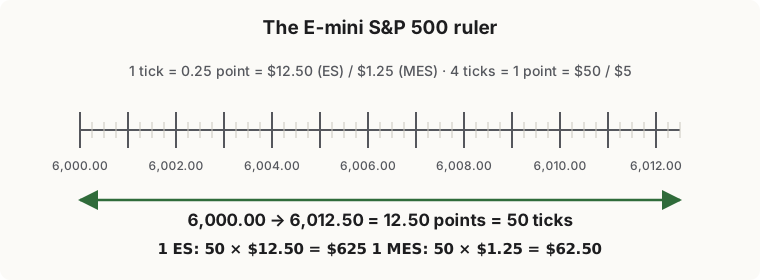
The two give the same answer, because tick value = tick size × multiplier. For the E-mini S&P 500: 0.25 × $50 = $12.50.
The contracts you will see most
The examples in this course use these contracts. The specifications are the exchange’s; the prices in the examples are made up for teaching.
| Contract (CME symbol) | Contract unit | Tick | Tick value | Point value |
|---|---|---|---|---|
| E-mini S&P 500 (ES) | $50 × index | 0.25 | $12.50 | $50 |
| Micro E-mini S&P 500 (MES) | $5 × index | 0.25 | $1.25 | $5 |
| E-mini Nasdaq-100 (NQ) | $20 × index | 0.25 | $5.00 | $20 |
| Micro E-mini Nasdaq-100 (MNQ) | $2 × index | 0.25 | $0.50 | $2 |
| Crude oil, WTI (CL) | 1,000 barrels | $0.01 | $10.00 | $1,000 per $1 |
| Micro WTI crude oil (MCL) | 100 barrels | $0.01 | $1.00 | $100 per $1 |
| Gold (GC) | 100 troy ounces | $0.10 | $10.00 | $100 per $1 |
| Micro Gold (MGC) | 10 troy ounces | $0.10 | $1.00 | $10 per $1 |
| Euro FX (6E) | 125,000 euros | 0.00005 | $6.25 | $12.50 per pip |
| Micro EUR/USD (M6E) | 12,500 euros | 0.0001 | $1.25 | $1.25 per pip |
| 10-Year Treasury Note (ZN) | $100,000 face value | ½ of 1/32 | $15.625 | $1,000 per point |
The Micro contracts are one-tenth of the full-size ones (the Micro EUR/USD is one-tenth of the Euro FX). They trade on the same exchange, follow the same prices and expire on the same schedule. For a new futures trader, they are the single most important product on this list: they let you trade the same market with one-tenth of the risk per tick.
Worked examples
E-mini S&P 500. You buy 1 ES at 6,000.00 and sell at 6,012.50. 12.50 points = 50 ticks. 50 × $12.50 = +$625. (Or 12.50 × $50 = $625.) With 1 MES instead: 50 × $1.25 = +$62.50.
Nasdaq-100. You sell 2 NQ at 21,500.00 and buy back at 21,560.00. The price rose 60 points against your short. 60 × $20 × 2 = −$2,400.
Crude oil. You sell 1 CL at $72.40 and buy back at $71.85. The price fell $0.55 = 55 ticks. 55 × $10 = +$550. With 1 MCL: 55 × $1 = +$55.
Gold. You buy 1 GC at $4,010.0 and sell at $4,025.5. $15.50 = 155 ticks. 155 × $10 = +$1,550. With 1 MGC: +$155.
Euro FX. You buy 1 6E at 1.12000 and sell at 1.12350. That is 35 pips, or 70 ticks of 0.00005. 70 × $6.25 = +$437.50, the same as 35 pips × $12.50. With 1 M6E: 35 × $1.25 = +$43.75.
10-Year Note. Treasury futures are quoted in points and 32nds of a point: 112’16 means 112 and 16/32. You buy 1 ZN at 112’16 and sell at 112’26. That is 10/32 = 20 half-ticks. 20 × $15.625 = +$312.50 (or 10/32 × $1,000 = $312.50).
Notional value: what one contract controls
notional value = price × multiplier (or price × contract unit)
| Contract | Example price | Notional value |
|---|---|---|
| ES | 6,000.00 | 6,000 × $50 = $300,000 |
| MES | 6,000.00 | 6,000 × $5 = $30,000 |
| CL | $72.40 | 72.40 × 1,000 = $72,400 |
| GC | $4,010.0 | 4,010 × 100 = $401,000 |
| 6E | 1.12000 | 1.12 × 125,000 = $140,000 |
| M6E | 1.12000 | 1.12 × 12,500 = $14,000 |
Notional value tells you the real size of your position. One ES is a $300,000 position in the S&P 500 whatever the margin deposit is. Class 3 compares the two to measure leverage.
Reading the symbol
A futures symbol is the product code, a month code and a year.
| Month | Jan | Feb | Mar | Apr | May | Jun | Jul | Aug | Sep | Oct | Nov | Dec |
|---|---|---|---|---|---|---|---|---|---|---|---|---|
| Code | F | G | H | J | K | M | N | Q | U | V | X | Z |
- ESZ6 (or ESZ26): the E-mini S&P 500 expiring in December 2026.
- CLF7: crude oil, January 2027 delivery month.
- 6EH7: Euro FX, March 2027.
Platforms add their own prefix. On thinkorswim, futures start with a slash: /ESZ26, /CLF27; typing just /ES shows the current front month. Always check the month on the order ticket. The same product in two months is two different contracts at two different prices (Class 4).
The Micro check
Before every trade, say the tick value out loud. A trader who means to trade MES ($1.25 a tick) and clicks ES ($12.50 a tick) has made a trade ten times larger than planned. Most platforms let you set a default quantity and product; set them to the contract you actually trade.
2 Check yourself
8 questions. Pass mark 70%. Retake as often as you like; your best score counts.