Margin, Leverage and Daily Settlement
1 Read
Read the class below, including each diagram, then tick the box.
This course is free to read. Sign in to tick off each class, take the quizzes and earn the certificate.
What you will be able to do
- Explain initial, maintenance and day-trade margin, and who sets each one.
- Follow a futures account through daily settlement and spot a margin call coming.
- Measure the real leverage of a position from its notional value.
- Explain how a futures account can end up owing money, and how to prevent it.
Margin is a deposit, not a down payment
In stocks, “buying on margin” means borrowing part of the price. Futures margin is different: nobody lends you anything, and you do not pay the contract’s value. Margin is a good-faith deposit (the exchange calls it a performance bond) that both the buyer and the seller post to show they can cover the day’s losses. When you close the position, the deposit is released.
There are three kinds:
| Margin | Set by | What it is |
|---|---|---|
| Initial margin | The exchange’s clearinghouse (your broker may require more) | What you must have to open a position held overnight |
| Maintenance margin | The clearinghouse (your broker may require more) | The level your account must stay above while the position is open; usually a little below initial |
| Day-trade margin | Your broker | A lower amount some brokers allow for positions opened and closed in the same session. It is the broker’s policy, not the exchange’s, and it can be changed or withdrawn at any time, especially in fast markets |
Margins are set from the contract’s recent volatility and are changed often. When markets get wild, exchanges raise them, sometimes with a day’s notice, and traders who are already stretched can be forced out. Check current figures on your broker’s platform; the numbers below are examples only.
Settlement every day
At the end of every trading day, the exchange publishes a settlement price for each contract. Every open position is marked to market at that price: the day’s gain is paid into the winners’ accounts and the day’s loss is taken out of the losers’ accounts, in cash, that night. This flow is called variation margin.
So a futures loss is never “on paper”. It leaves your account every day it happens.
A margin call, day by day
Example figures: one ES contract, initial margin $24,000, maintenance margin $22,000. You open the account with $30,000 and buy 1 ES at 6,000.00. Each point is $50.
| Day | Settlement | Change (points) | Day’s variation | Account balance | Above maintenance? |
|---|---|---|---|---|---|
| 0 | 6,000.00 (entry) | — | — | $30,000 | Yes |
| 1 | 6,020.00 | +20 | +$1,000 | $31,000 | Yes |
| 2 | 5,990.00 | −30 | −$1,500 | $29,500 | Yes |
| 3 | 5,950.00 | −40 | −$2,000 | $27,500 | Yes |
| 4 | 5,905.00 | −45 | −$2,250 | $25,250 | Yes |
| 5 | 5,850.00 | −55 | −$2,750 | $22,500 | Yes, just |
| 6 | 5,830.00 | −20 | −$1,000 | $21,500 | No: margin call |
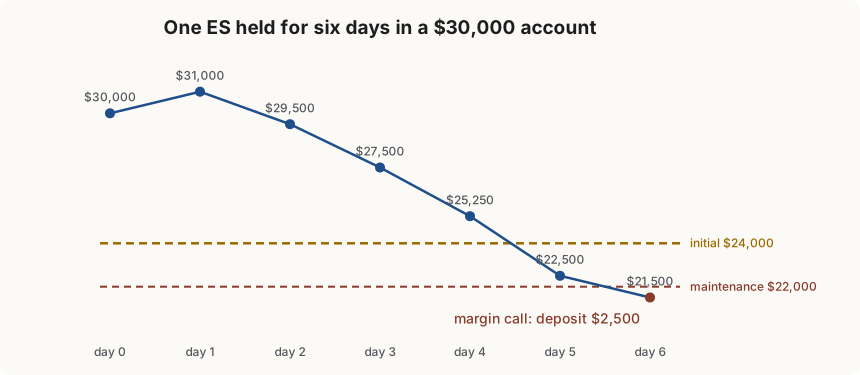
On day 6 the balance, $21,500, is below the $22,000 maintenance margin. The broker issues a margin call: you must bring the account back up, usually to the initial margin of $24,000, so you must deposit $2,500, or reduce the position. If you do neither, quickly, the broker will close the position for you, at the market, without asking.
Two lessons from the table:
- The index fell only 2.8% (6,000 to 5,830), and the account lost $8,500, more than a quarter of its money.
- The margin call came after the losses. Margin is not a stop. It only tells you, late, that the position was too large for the account.
Measuring leverage
Margin hides the real size of a futures position. Measure leverage from the notional value (Class 2):
leverage = notional value ÷ account equity
| Notional | Equity | Leverage | A 1% move is | |
|---|---|---|---|---|
| 1 ES at 6,000, $30,000 account | $300,000 | $30,000 | 10 to 1 | $3,000, 10% of the account |
| 1 MES at 6,000, $30,000 account | $30,000 | $30,000 | 1 to 1 | $300, 1% of the account |
| 3 MES at 6,000, $30,000 account | $90,000 | $30,000 | 3 to 1 | $900, 3% of the account |
The exchange’s margin would let this account hold one ES. That does not make one ES a sensible size. On a $30,000 account, the Micro lets you choose leverage deliberately: 1 to 1 behaves like owning $30,000 of an index fund; 3 to 1 is aggressive; 10 to 1 can lose a tenth of the account on an ordinary day. Class 9 turns this into a sizing rule based on your stop, not on margin.
Excess margin and buying power
Excess is the money in your account above the margin required for open positions. It is what absorbs losses before a margin call, and what you can use to open new positions. A position that uses most of your account as margin leaves almost no room for a normal day’s swing.
A useful habit: keep the margin in use to a small share of the account (many careful traders keep it under a quarter or a third) so that ordinary volatility never comes close to a call.
Losing more than the account
A stop or a broker’s forced liquidation closes your position at the next available price, not at the price you hoped for. In a gap, that can be far away.
- Overnight and weekend gaps. Futures trade nearly around the clock, but they still stop for the daily break and the weekend (Class 5). News that arrives then can open the market well beyond your stop.
- Fast markets. During major reports or shocks, prices can skip many ticks between trades.
- The extreme case. On April 20, 2020, the May WTI crude oil contract (CL) settled at −$37.63 a barrel: holders of long positions near expiration had to pay to get out, because storage for delivered oil had run out. Long positions lost more than the entire value of the oil.
If losses exceed your account balance, the account goes negative, and you owe the broker the difference. This is called a debit balance, and brokers collect it. The protection is simple, and it is the subject of Class 9: trade a size whose worst realistic gap you could survive, and do not hold positions into delivery (Class 4).
2 Check yourself
7 questions. Pass mark 70%. Retake as often as you like; your best score counts.