Expiration, Delivery and the Roll
1 Read
Read the class below, including each diagram, then tick the box.
This course is free to read. Sign in to tick off each class, take the quizzes and earn the certificate.
What you will be able to do
- Say whether a contract settles in cash or by delivery, and why it matters to you.
- Find the dates that matter for a contract and stay clear of delivery.
- Roll a position from one month to the next, and price the roll.
- Read the futures curve: contango and backwardation.
- Recognize the jump a continuous chart makes at the roll.
Every contract ends
Each futures contract has an expiration. Several months of the same product trade at once, at different prices. The one nearest to expiration with the most trading is called the front month; the others are deferred months.
At expiration, open positions are settled in one of two ways:
| Settlement | What happens | Examples |
|---|---|---|
| Cash | Open positions are marked to a final settlement price, and the last day’s gain or loss is paid in cash. Nothing is delivered. | E-mini and Micro E-mini stock index futures, Micro WTI crude oil (MCL) |
| Physical delivery | Shorts deliver the actual underlying and longs pay for it and receive it. | WTI crude oil (CL, delivered in Cushing, Oklahoma), gold (GC), currency futures such as 6E, Treasury futures such as ZN |
Check the Settlement method line of the specification sheet for every contract you trade. With a cash-settled contract, holding to expiration simply closes the trade at the final price. With a physically delivered contract, a speculator must be out before the delivery process starts.
The dates that matter
For physically delivered contracts, two dates matter:
- First notice day (FND): the first day a short can notify the exchange that it intends to deliver. From then on, a long who still holds the contract can be assigned delivery: required to accept and pay for 1,000 barrels of oil, or 100 ounces of gold, or €125,000.
- Last trading day (LTD): the last day the contract trades. For some contracts, such as WTI crude oil, trading stops before the delivery month begins: CL stops trading about three business days before the 25th of the month before delivery.
Retail brokers do not want customers taking delivery. Most require you to close or roll physically delivered positions several days before first notice day (or before last trading day if that comes first), and will liquidate positions that are still open at their deadline. Find your broker’s deadline for each contract; it is often earlier than the exchange’s dates.
For E-mini stock index futures, trading ends on the third Friday of the contract month (March, June, September and December), and the final settlement is based on the opening prices of the index’s stocks that morning. The December 2026 contract (ESZ6) expires on Friday, December 18, 2026.
Rolling a position
To keep a position past expiration, you roll it: close the expiring contract and open the same position in the next month.
Volume moves from the expiring contract to the next one over a few days before expiration. For stock index futures, most of the move happens about a week before expiration; for CL, the roll happens before the front month’s last trading day each month. Charts and platforms show the shift as volume falling in one month and rising in the next. Trade the contract with the volume. Liquidity, and tight spreads, follow it.
Example: rolling a long ES position from December to March in the week before December’s expiration:
- ESZ6 (December) is at 6,040.00.
- ESH7 (March) is at 6,082.00.
You sell 1 ESZ6 at 6,040.00 and buy 1 ESH7 at 6,082.00. Your exposure to the S&P 500 is the same, but your new position is at a price 42.00 points higher. That is not a loss: the March contract is priced higher because of the cost of carry (Class 6), and both contracts will converge to the index at their own expirations.
Calendar spreads
Rather than placing two separate orders, you can trade the roll as one calendar spread: a single order that sells one month and buys another at a net price (here, +42.00). Exchanges list calendar spreads as their own instruments, so both legs fill together at one price, often with a tighter spread than the two legs separately.
Contango and backwardation
Line up the prices of every month of one contract and you get the futures curve.
- Contango: later months are priced higher than nearer months. This is normal when holding the underlying costs money: storage and insurance for oil and gold, interest for a stock index. Stock index futures are usually in contango because interest rates are higher than dividend yields.
- Backwardation: later months are priced lower than nearer months. It appears when the underlying is wanted now: tight oil supplies, for example, push the front month above later ones.
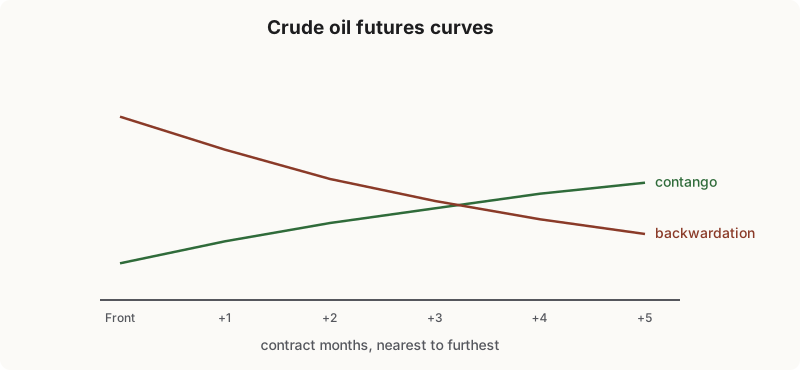
Why it matters to a trader who rolls:
- A long position rolled in contango keeps selling the cheaper expiring month and buying the dearer next month. Over many rolls, this costs a long holder money compared with the spot price, which is why long-term commodity funds can lag the commodity.
- In backwardation, the roll works in the long’s favor.
Convergence
As expiration approaches, a futures price converges to the price of the underlying, because on the last day they are the same thing. The difference between the futures price and the spot (cash) price is called the basis. It shrinks toward zero as time passes. Class 6 shows how to calculate the fair basis for stock index futures.
Continuous charts jump at the roll
Every futures contract has a short life, so long-term charts are built by joining contracts together: the December contract until the roll, then March, and so on. This is a continuous chart.
- An unadjusted continuous chart (thinkorswim’s /ES chart, for example, follows the front month) shows a jump at each roll equal to the price difference between the two months: in the example above, 42 points.
- A back-adjusted continuous chart shifts all the older prices by the roll difference so that there is no jump. Its older prices are no longer the prices that actually traded, but its moves are correct.
Neither is wrong; they answer different questions. What matters is to know which one you are looking at. A roll gap on an unadjusted chart is not a market move and must not be read as one. Class 10 shows how it affects the Outer Box.
The April 2020 lesson
When the May 2020 crude oil contract settled at −$37.63 (Class 3), the cause was delivery. Holders of long contracts near expiration who could not take delivery of oil, because storage in Cushing was nearly full, had to sell at any price before trading ended. A trader who rolls or closes physically delivered positions well before the delivery dates is never part of that kind of squeeze.
2 Check yourself
7 questions. Pass mark 70%. Retake as often as you like; your best score counts.