Sessions, Reports and Price Limits
1 Read
Read the class below, including each diagram, then tick the box.
This course is free to read. Sign in to tick off each class, take the quizzes and earn the certificate.
What you will be able to do
- Say when the futures you trade are open, and where each trading day begins and ends.
- Know when liquidity is deep and when it is thin.
- Know the scheduled reports that move stock index, energy, metal, currency and rate futures, and plan around them.
- Explain price limits and circuit breakers, and what they mean for a stop order.
The futures day: 6 p.m. to 5 p.m. New York
Most CME Group futures (stock indexes, currencies, interest rates, energy and metals) trade on CME Globex nearly around the clock:
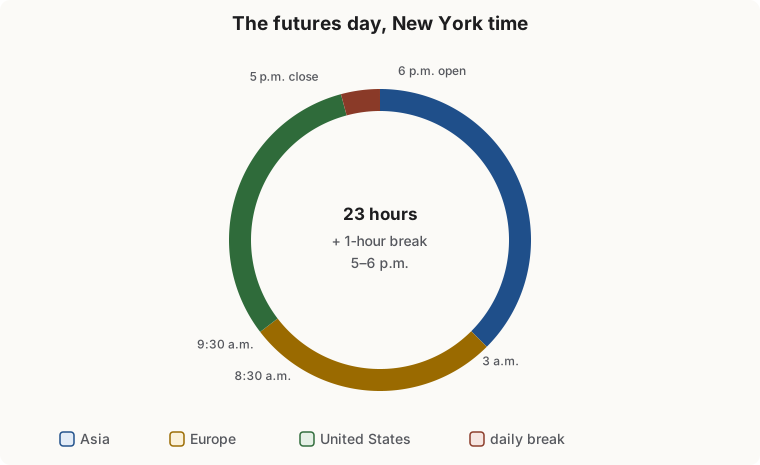
- Sunday 6:00 p.m. to Friday 5:00 p.m., New York time,
- with a one-hour break every afternoon, from 5:00 to 6:00 p.m.
Each trading day starts at 6:00 p.m. and ends at 5:00 p.m. the next afternoon, and is named for the day it ends. Monday’s session opens on Sunday evening; Friday’s ends at 5 p.m. on Friday. This is the same 5 p.m. New York cut used for forex in Outer Box Foundations, and it matters for drawing the daily box (Class 10).
Some products have shorter hours, and every product has changed hours on U.S. holidays. CME publishes a holiday calendar each year; check it before you hold a position into a holiday.
Three sessions in one day
Liquidity, and how far prices move, depend on who is awake.
| Session (New York time) | Who is trading | What to expect |
|---|---|---|
| Asia, 6:00 p.m. to about 3:00 a.m. | Asian and Australian markets | Quietest for U.S. index and energy futures; most active for yen and Australian dollar contracts |
| Europe, about 3:00 a.m. to 9:30 a.m. | London, Frankfurt, Paris | Busier; euro, pound and Bund-related moves; volume builds toward the U.S. open |
| United States, 9:30 a.m. to 4:00 p.m. (stocks), plus 8:30 a.m. data | U.S. stock market, U.S. economic reports | The deepest liquidity in stock index futures; the largest moves of the day often come at 8:30, 9:30 and 10:00 a.m. |
The quieter hours have wider spreads and thinner order books. A market order or a stop that triggers at 2 a.m. may fill several ticks away from where it would fill at 10 a.m. If you trade outside U.S. hours, use limit orders and smaller size.
The period from the U.S. stock market close (4:00 p.m.) to the futures break (5:00 p.m.) is also busy for index futures, because large companies often report earnings right after 4:00 p.m.
The settlement price
Each contract’s daily settlement price, the price used for marking accounts to market (Class 3), is calculated in a short window near the end of the U.S. trading day, not at the 5 p.m. close. Examples from the exchange’s methods:
- Stock index futures: based on trading in the 30 seconds up to 4:15 p.m. New York time.
- WTI crude oil: based on trading from 2:28 to 2:30 p.m. New York time.
You do not need the method for every product, but know that the price your account is settled at is not necessarily the last price on your chart.
The reports that move futures
Scheduled economic releases cause the largest, fastest moves of most weeks. Know when they are, and decide in advance whether you will hold a position through them. All times are New York time.
| Report | When | Moves most |
|---|---|---|
| U.S. Employment Situation (nonfarm payrolls, unemployment rate) | Usually the first Friday of the month, 8:30 a.m. | Everything: index, rates, currencies, gold |
| Consumer Price Index (CPI) | Mid-month, 8:30 a.m. | Rates, index, currencies, gold |
| Federal Reserve (FOMC) rate decision | Eight scheduled meetings a year, 2:00 p.m., press conference at 2:30 p.m. | Everything |
| Retail sales, producer prices, GDP | Monthly or quarterly, 8:30 a.m. | Index, rates, currencies |
| ISM manufacturing and services surveys | Early in the month, 10:00 a.m. | Index, rates |
| EIA Weekly Petroleum Status Report (crude inventories) | Wednesdays, 10:30 a.m. | Crude oil (CL, MCL) |
| Earnings of the largest companies | Often just after 4:00 p.m. | Nasdaq-100 and S&P 500 futures |
| Central bank decisions abroad (ECB, Bank of Japan, Bank of England) | Their own schedules | The matching currency futures |
What a report does to the market: in the seconds after the release, the order book can empty as traders pull their orders, then refill at new prices. Spreads widen, stops can fill many ticks away (slippage), and prices can whip in both directions before settling. A beginner’s simplest rule is to be flat (no position) a few minutes before a major report and to wait a few minutes after it before entering.
Keep an economic calendar open on your platform. thinkorswim and most broker platforms show one, with each report’s time and the previous figure.
Price limits and circuit breakers
Exchanges limit how far or how fast some futures can move, to give the market time to absorb shocks.
Stock index futures.
- During U.S. stock market hours, index futures halts are coordinated with the stock market’s circuit breakers, which trigger at declines of 7%, 13% and 20% in the S&P 500 from the previous close. A 7% or 13% decline halts trading for 15 minutes (if it happens before 3:25 p.m.); a 20% decline stops trading for the rest of the day.
- Outside stock market hours, the index futures have a limit of 7% up or down from the previous day’s reference price. Prices can trade at the limit but not beyond it until the stock market opens.
Other futures, such as crude oil, use dynamic limits: if the price moves more than a set amount within a short window, trading pauses briefly (typically two minutes), the band is widened, and trading resumes.
What limits mean for you: a stop order cannot fill while trading is halted or while the price is locked at a limit. When trading resumes, it fills at the first available price, which may be far beyond your stop. Limits slow a crash down; they do not protect an individual position from it.
Planning your trading hours
Choose the hours you will trade, write them in your plan (Class 9), and match them to your market:
- Stock index futures: the cleanest movement is usually from 9:30 a.m. to about 11:30 a.m. and from about 2:00 p.m. to 4:00 p.m. New York time.
- Crude oil: most active from about 9:00 a.m. to 2:30 p.m., with the Wednesday 10:30 a.m. inventory report.
- Currency futures: follow the currency’s home session, plus the U.S. morning.
- Avoid the first and last minutes around the daily break and the few minutes around major reports, unless trading those moments is your strategy.
2 Check yourself
7 questions. Pass mark 70%. Retake as often as you like; your best score counts.