Futures Through the Outer Box
1 Read
Read the class below, including each diagram, then tick the box.
This course is free to read. Sign in to tick off each class, take the quizzes and earn the certificate.
What you will be able to do
- Draw the daily, weekly and monthly boxes on a futures chart with the right session.
- Keep the boxes correct across a roll, and on currency futures.
- State every ladder level as a price, a distance in ticks and an amount in dollars.
- Plan a complete futures trade from an Outer Box reading: entry, stop, targets, size and management.
Rule 1: the box follows the futures day
A box is the high and low of a completed period. For futures, the period has to match the way the market actually trades:
- Daily box: the Globex day, 6:00 p.m. to 5:00 p.m. New York, named for the day it ends (Class 5). This is the same 5 p.m. cut the book uses for currencies, so a futures daily box and a forex daily box cover the same hours.
- Weekly box: Sunday 6:00 p.m. to Friday 5:00 p.m.
- Monthly and yearly boxes: all the trading days that end in that month or year.
Do not build the daily box from the stock market’s hours (9:30 a.m. to 4:00 p.m.) unless you deliberately trade a regular-hours box; if you do, use it consistently on every timeframe. The overnight session is not noise: it is part of the futures day, and its high and low are levels the U.S. session reacts to (Class 6). Inside the daily box, the overnight range is simply a smaller box.
On thinkorswim, daily candles on futures charts already run on the 6 p.m. to 5 p.m. session, so the Outer Box study’s daily, weekly and monthly boxes line up with the rules above when it is applied to a futures chart.
Rule 2: one contract, or an adjusted chart, across the roll
A futures contract lives about three months (stock indexes) or one month (crude oil). Larger boxes can span a roll, and that causes a problem:
- On an unadjusted continuous chart (/ES), the September box was drawn on the September contract and the October prices are the December contract’s, which trade about 40 points higher (Class 4). The old box’s levels are in the wrong place for the new contract.
The fixes, in order of simplicity:
- Daily and weekly boxes: draw them from the contract you trade (for example /MESZ26). They rarely span a roll, and in roll week, switch to the new contract for the next box.
- Monthly and yearly boxes: draw them from a back-adjusted continuous chart, which removes the roll jumps, or add the roll difference (the price gap between the two contracts on the roll date) to the old box’s levels.
- Never read a roll gap as a breakout. A 42-point jump on the roll date is the change of contract, not the market clearing a level.
Currency futures add one more rule: draw the boxes from the futures chart, not from spot. 6E trades some pips away from EUR/USD because of the interest difference (Class 7), so spot levels copied onto 6E are off by that amount. For the yen, remember the mirror: the 6J box is the USD/JPY box upside down, so a bullish USD/JPY reading is a bearish 6J reading, and a USD/JPY R1 is a 6J S1.
Rule 3: say every level in ticks and dollars
The ladder gives prices. Futures turn those into ticks and money. Take the Micro E-mini S&P 500 (MES), $1.25 a tick, $5 a point.
The monthly box (direction box). September’s box on the December contract (back-adjusted): R1 6,120.00, S1 5,880.00, range 240 points. C is 6,000.00. October is trading above it: the monthly reading is bullish.
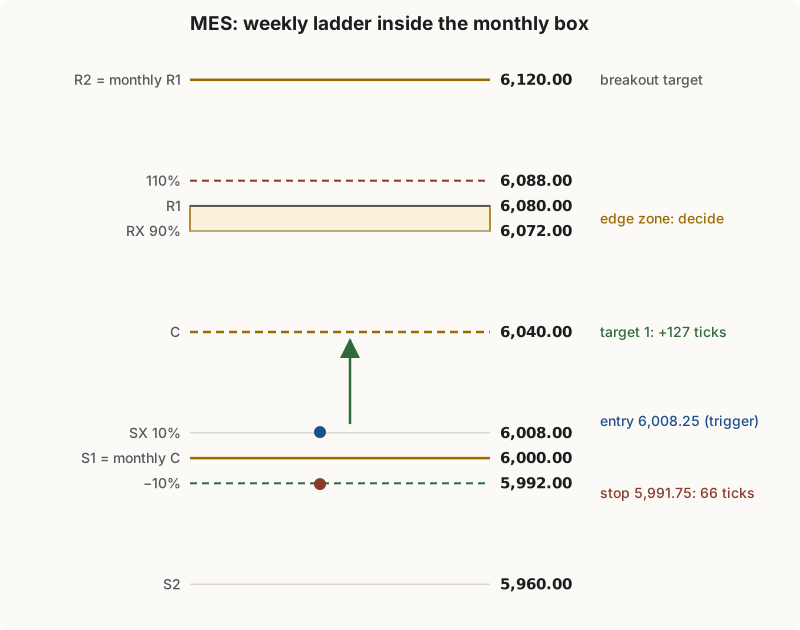
The weekly box (trading box). Last week’s box: R1 6,080.00, S1 6,000.00, range 80 points = 320 ticks = $400 per MES.
| Level | % | Price | Ticks from S1 | Dollars from S1, 1 MES |
|---|---|---|---|---|
| R2 | 150% | 6,120.00 | 480 | $600 |
| 110% | 110% | 6,088.00 | 352 | $440 |
| R1 | 100% | 6,080.00 | 320 | $400 |
| RX | 90% | 6,072.00 | 288 | $360 |
| C | 50% | 6,040.00 | 160 | $200 |
| SX | 10% | 6,008.00 | 32 | $40 |
| S1 | 0% | 6,000.00 | 0 | $0 |
| −10% | −10% | 5,992.00 | −32 | −$40 |
| S2 | −50% | 5,960.00 | −160 | −$200 |
Two things stand out before any trade:
- The weekly S1 (6,000.00) is the monthly C. Two boxes agree on one level: support where the larger box’s bias is decided.
- The weekly R2 (6,120.00) is the monthly R1. The first breakout target of the weekly box is the top of the monthly box.
Rule 4: the trade, step by step
The reading (Chapter 19 of the book). Direction box (monthly) bullish, above C. This week, price pulls back to 6,001.50, testing the weekly S1 at the monthly C, then rises back through SX at 6,008.00: a weekly bullish sentiment trigger, in the direction the monthly box favours. This is the book’s pullback trade.
Entry: a buy stop one tick above SX, filled at 6,008.25. Chapter 21: enter on the trigger, not at the level before the test.
Stop: beyond the threshold that would make the reading wrong. A close below S1 is not enough to prove it wrong; a move beyond −10% at 5,992.00 is. Stop at 5,991.75, one tick beyond.
Stop distance: 6,008.25 − 5,991.75 = 16.50 points = 66 ticks.
Targets:
- Weekly C at 6,040.00: 31.75 points = 127 ticks above entry. Take part of the position here.
- The weekly edge zone, 6,072.00 (RX) to 6,080.00 (R1): 63.75 to 71.75 points above entry. At the edge zone the top-of-box rules take over: a rejection is the exit; a failed rejection and a close above 110% (6,088.00) points to R2 at 6,120.00, the monthly R1.
Size (Class 9): $25,000 account, 1% = $250, 2 ticks of slippage, $2.50 fees:
Risk per MES = (66 + 2) × $1.25 + $2.50 = $87.50
250 ÷ 87.50 = 2.86 → 2 MES ($175 at risk)
| Outcome | Ticks | 2 MES |
|---|---|---|
| Stopped at 5,991.75 (with 2 ticks of slippage) | −68 | −$170, plus fees |
| First target, C at 6,040.00 | +127 | +$317.50 |
| Edge zone, RX at 6,072.00 | +255 | +$637.50 |
Size by alignment. Monthly bullish, weekly trigger bullish, and the daily boxes stepping up: the boxes agree, so the full 1% applies. If the daily boxes were stepping down (the trading box against the direction box), the book’s rule is a reduced position, here 1 MES, with the weekly C as the only target. The Target Grader on the site gives the same answer as a Strong, Moderate or Weak grade.
Rule 5: manage the trade one level at a time
The bracket from Class 8 places the stop and the first target the moment the entry fills. After that, the ladder says what to do at each level:
- At C (6,040.00): sell 1 MES (+$158.75 on that contract). Move the stop on the remaining contract to just below SX (6,007.75), which is now the level that would make the reading wrong: Chapter 21’s “a long above C can have its stop beneath the 10% level”. The rest of the trade is now close to risk-free, apart from gaps.
- At the edge zone (6,072.00 to 6,080.00): decide by the top-of-box rules. A rejection back below RX is the exit. A push through R1 that holds and a close above 110% (6,088.00) is a hold for R2 (6,120.00), with the stop moved up behind the last confirmed level.
- If the weekly reading fails (a move back below 5,992.00 before C), the stop takes you out. No widening, no averaging down.
- Overnight: run the gap test (Class 9) before holding through the 5 p.m. close. With 1 MES left and its stop near entry, the test is usually easy to pass; with a full position on the first day, it may not be.
Rule 6: the daily box and the chain on futures
Everything from Outer Box Foundations about the chain reaction applies to futures, measured on the futures day:
- The daily boxes stepping up (each day’s live C above the last completed C) while price holds above the daily C is the first link of a bullish chain.
- The weekly box connects when price clears the weekly levels in order; the monthly box follows.
- The reading only changes when price clears the levels of the box that set the direction.
On futures, two practical checks come first: is the daily box built on the 6 p.m. to 5 p.m. day, and does any box span a roll without an adjustment? If both are right, the chain on /MES reads exactly as it does on EUR/USD.
The futures checklist for a ladder trade
- Session: daily box on the 6 p.m. to 5 p.m. New York day.
- Contract: the active month; larger boxes adjusted across the roll; currency boxes from the futures chart (6J mirrored).
- Reading: direction box, trading box, the trigger that fired, the trade shape.
- Levels: entry, stop beyond the threshold, first and second targets, in price, ticks and dollars.
- Size: by the stop in ticks with slippage and fees; reduced if the boxes disagree; within the leverage ceiling.
- Calendar: no major report or roll deadline inside the trade without a plan for it.
- Bracket: stop and first target working from the moment of entry.
2 Check yourself
8 questions. Pass mark 70%. Retake as often as you like; your best score counts.