Risk, Sizing and the Futures Plan
1 Read
Read the class below, including each diagram, then tick the box.
This course is free to read. Sign in to tick off each class, take the quizzes and earn the certificate.
What you will be able to do
- Size any futures trade from your account, your risk per trade and your stop in ticks.
- Include slippage and fees in the risk, not just the stop distance.
- Decide whether a position is safe to hold overnight with a gap test.
- Set daily and weekly loss limits that stop a bad day from becoming a bad month.
- Keep a futures journal and write a one-page plan.
Size by the stop, never by the margin
The margin tells you the most you are allowed to trade. It says nothing about what you should trade. The right size comes from your stop:
risk per contract = (stop distance in ticks + slippage in ticks) × tick value + round-trip fees
contracts = money you will risk ÷ risk per contract (rounded down)
Example account: $25,000, risking 1% per trade = $250. Allow 2 ticks of slippage on the stop.
| Market and stop | Contract | Risk per contract | Contracts | Money at risk |
|---|---|---|---|---|
| S&P 500, stop 12.50 points (50 ticks) | ES | 52 × $12.50 + $5 = $655 | 0 | — |
| MES | 52 × $1.25 + $2.50 = $67.50 | 3 | $202.50 | |
| Crude oil, stop $0.40 (40 ticks) | CL | 42 × $10 + $5 = $425 | 0 | — |
| MCL | 42 × $1 + $2.50 = $44.50 | 5 | $222.50 | |
| Euro, stop 30 pips | 6E (60 ticks) | 62 × $6.25 + $5 = $392.50 | 0 | — |
| M6E (30 ticks) | 32 × $1.25 + $2.50 = $42.50 | 5 | $212.50 |
(Fees are the illustrative figures from Class 8.)
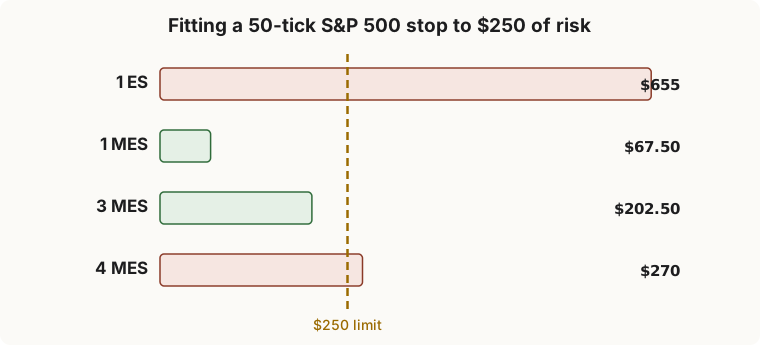
The table makes the main point of this class: on a $25,000 account, none of the full-size contracts fits a 1% risk with a sensible stop. Without Micros, the only way to trade them would be to shrink the stop until it sits inside normal noise, which is how most new futures traders are stopped out of trades that would have worked. With Micros, the stop goes where the market says it belongs, and the size adjusts.
Never move the stop closer to make a bigger size fit. The stop belongs where the trade is proven wrong (Class 10 shows where that is on the ladder); the size is what is left to adjust.
Check the leverage too
After sizing by the stop, check the notional exposure (Class 3):
- 3 MES at 6,000 = 3 × $30,000 = $90,000 on a $25,000 account: 3.6 to 1.
- 5 MCL at $70 = 5 × $7,000 = $35,000: 1.4 to 1.
If a tight stop allowed a very large number of contracts, the notional leverage will be high even though the stop risk looks small, and a gap through the stop would be expensive. Many traders set a ceiling as well, for example no more than 3 to 5 times leverage in total, whatever the stop says.
The overnight gap test
A stop does not protect you while the market is closed or halted (Class 5). Before holding a position overnight or over a weekend, ask: what would a large gap cost?
gap loss = gap size in points × point value × contracts
For 3 MES, test a 3% overnight gap in the S&P 500 at 6,000: 180 points × $5 × 3 = $2,700, nearly 11% of the account.
If that number is more than you could accept, do one of three things before the close: reduce the position, close it, or hedge it (for example, with a put option on the future). Many short-term traders simply decide not to hold futures overnight at all; that decision belongs in the plan.
Loss limits for the day and the week
Futures move fast enough that a trader can lose a week’s results in an hour, usually by trading more and larger after a loss. Set limits that stop you mechanically:
- Daily loss limit: for example, 2% of the account or two losing trades, whichever comes first. When it is hit, you stop trading for the day: close the platform.
- Weekly loss limit: for example, 5%. When it is hit, stop until the next week and review the journal before you start again.
- Many platforms can enforce these, blocking new orders after a set loss. Use that feature if it exists.
The limits are not punishment. They keep a bad day small enough that a normal day can repair it.
Correlated positions are one position
- Long ES and long NQ is mostly one bet on U.S. stocks, at roughly double the risk.
- Long gold and short the dollar index are related bets.
- Short 6J and long USD/JPY in a spot account are the same bet (Class 7).
Add up the risk of related positions and hold them to the limit for a single trade, or to a slightly higher combined limit that you write in the plan.
The futures journal
Record, for every trade:
| Field | Example |
|---|---|
| Date and session | Oct 21, U.S. session |
| Contract and month | MESZ6 |
| Direction, size | Long 3 |
| Entry, stop, target | 6,000.00 / 5,987.50 / 6,025.00 |
| Planned risk | 50 ticks + 2 slippage, $202.50 |
| Reason | Daily bullish sentiment trigger at SX, weekly box above C (Class 10) |
| Exit and result | 6,025.00, +$375 less fees |
| Slippage on exit | 0 ticks (limit) |
| Rules followed? | Yes |
| Lesson | Waited for the trigger instead of buying at the level |
After 20 to 30 trades, total them: win rate, average win, average loss, expectancy (see Trading Options, Class 9, for the formula), average slippage and total fees. Fees and slippage are often larger than traders expect; the journal shows the real numbers.
Common mistakes
- Trading full-size contracts on an account that only fits Micros.
- Sizing by the margin instead of by the stop.
- Entering without a working stop, even “for a second”.
- Holding through major reports or overnight without a gap test.
- Holding physically delivered contracts too close to first notice day.
- Trading the wrong contract month in roll week.
- Adding to a losing position, or trading bigger to “win it back”.
Your one-page futures plan
- Markets and contracts: for example, MES and MCL only.
- Hours: for example, 9:30 to 11:30 a.m. and 2:00 to 4:00 p.m. New York; flat 5 minutes before major reports; no positions held overnight (or: overnight only after the gap test).
- Setups: the entries you take, stated as levels (Class 10).
- Risk per trade: for example, 1% of the account, sized by the stop in ticks with slippage and fees.
- Leverage ceiling: for example, total notional no more than 3 times the account.
- Loss limits: daily 2% or two losses; weekly 5%.
- Rolls and deliveries: the broker’s deadline for each contract, in the calendar.
- Review: journal every trade; review weekly; change one rule at a time.
Members can keep the plan on the site’s Plan page.
2 Check yourself
7 questions. Pass mark 70%. Retake as often as you like; your best score counts.