Orders, Execution and the Platform
1 Read
Read the class below, including each diagram, then tick the box.
This course is free to read. Sign in to tick off each class, take the quizzes and earn the certificate.
What you will be able to do
- Choose the right order type for an entry, a stop and a target.
- Place a bracket that sends the stop and target the moment you are filled.
- Read the depth of market (DOM) and estimate slippage.
- Add up the full cost of a round trip, and see why it matters more on Micros.
- Set up your platform to prevent the most expensive mistakes.
The four order types
| Order | What it does | Use it for | Risk |
|---|---|---|---|
| Market | Fills now at the best available price | Getting out fast | Slippage in fast or thin markets |
| Limit | Fills only at your price or better | Entries at a level; profit targets | May not fill at all |
| Stop (stop-market) | Becomes a market order when the price trades at your stop | Protective stops | Fills beyond the stop in a gap or fast market |
| Stop-limit | Becomes a limit order when the stop price trades | Entries on a breakout where you will not chase beyond a price | May not fill, so never use one as a protective stop |
A buy stop sits above the market (it triggers when price rises to it); a sell stop sits below. A buy limit sits below the market; a sell limit sits above.
Time in force: a day order is cancelled at the end of the trading day (5 p.m. New York); a GTC (good till cancelled) order stays until it fills or you cancel it. Protective stops for positions you hold overnight must be GTC, or re-entered each day.
Brackets: entry, stop and target together
A bracket order attaches a stop and a target to your entry. When the entry fills, both are sent; when one of them fills, the other is cancelled (one cancels the other, OCO).
Example: buy 2 MES at 6,000.00 with a limit order; stop at 5,987.50; target at 6,025.00.
- Risk: 12.50 points = 50 ticks × $1.25 × 2 = $125.
- Reward: 25.00 points = 100 ticks × $1.25 × 2 = $250.
- If the target fills, the stop is cancelled automatically, and the reverse.
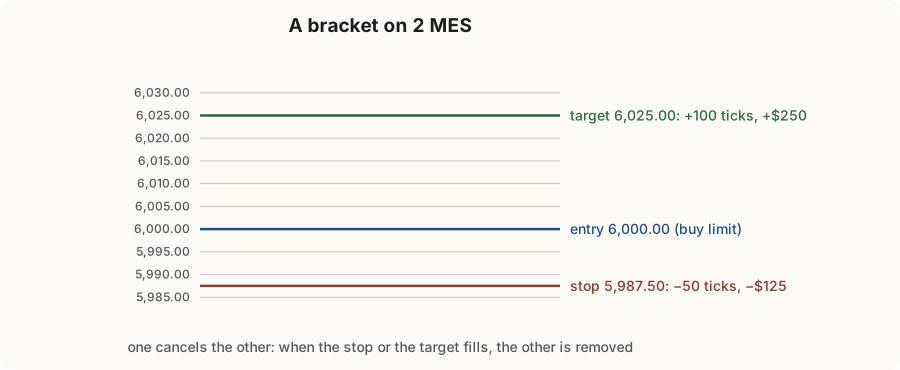
Brackets protect you from the most dangerous gap in futures trading: the moment between being filled and placing your stop. Every position should have its stop working from the instant it opens. Platforms let you save bracket templates (“50-tick stop, 100-tick target”) so it happens with one click.
The depth of market (DOM)
The DOM (on thinkorswim, the Active Trader ladder) is a vertical price ladder showing the orders waiting at each price:
- Bid size: contracts waiting to buy at each price below the market.
- Ask size: contracts waiting to sell at each price above it.
- The inside market is the best bid and best ask, usually one tick apart in active contracts.
The DOM helps you see liquidity. If you want to sell 10 ES and there are 300 contracts bid at the best price, you will fill there. If you are trading a thin contract at 3 a.m. and only 4 are bid, then 3 at the next tick down, then 2, a 10-lot market order will walk down the book and fill at several worse prices. That difference from the price you expected is slippage.
Reading the DOM well is a skill of its own. For this course, use it for two things: check that there is enough size at the inside market for your order, and click your limit orders onto the exact price you want.
Slippage
Slippage is the gap between the price you expected and the price you got. It is small for limit orders (zero, if they fill), and it is a cost on market and stop orders. Expect more of it:
- in the seconds after a major report;
- in thin hours (overnight, around the daily break, holidays);
- in less active contracts or months;
- with larger orders.
Plan for it: add a tick or two of slippage to every stop in your risk calculation, more around reports.
The full cost of a round trip
A round trip is opening and closing one contract. Its cost has several parts:
- your broker’s commission (per contract, each side);
- exchange and clearing fees (per contract, each side);
- the NFA fee (a few cents per contract);
- the bid-ask spread (usually one tick, paid when you cross it);
- slippage on market and stop orders;
- and, monthly, market data fees for real-time CME prices (often waived or small for non-professional users).
Fees differ by broker and contract. Suppose, for illustration, the commission and fees come to $2.50 a round trip on MES and $5.00 on ES.
| MES | ES | |
|---|---|---|
| Tick value | $1.25 | $12.50 |
| Round-trip fees | $2.50 | $5.00 |
| Fees in ticks | 2 ticks | 0.4 tick |
| Plus one tick of spread | 3 ticks | 1.4 ticks |
On the Micro, a round trip costs about three ticks before the market has moved; on the E-mini, under one and a half. That does not make Micros a bad product; they are the right size for most accounts. It means very short-term trading for a few ticks is much harder on Micros, and that targets and stops should be wide enough that costs are a small part of them.
Options on futures
Most major futures have options that use the future as their underlying: options on ES, NQ, CL, GC, 6E, ZN and others, including weekly and daily expirations on the most active ones. Everything in Trading Options applies, with three differences:
- The multiplier is the future’s: an option on ES moves $50 per index point of premium, not $100 per share.
- Exercise gives you a futures position, not shares.
- The option’s expiration may come before the future’s (a weekly option on the December future, for example).
Read the product’s option specifications before trading one.
Setting up the platform
A few settings prevent the most expensive mistakes:
- Default contract and quantity. Set the platform to the contract you trade (MES, not ES) and your normal size, so a stray click cannot send ten times your size.
- Bracket template attached to every entry.
- Display tick value or position P/L in dollars, so you see money, not just points.
- Check the contract month on every new chart and ticket, especially in roll week.
- Alerts for the levels in your plan, so you are not staring at the screen waiting.
- Practice first. Most platforms (thinkorswim’s paperMoney among them) have a simulated mode. Place at least a few dozen practice trades with brackets before using real money.
Rules and tax basics (United States)
- Approval: your broker must approve the account for futures. Requirements vary by firm (account type, experience and a minimum balance are common).
- Day-trading rules: the U.S. pattern day trader rule for stock and options accounts never applied to futures; futures accounts are governed by futures margin rules. (That stock-account rule was itself replaced in 2026; see Trading Options, Class 8.)
- Tax: regulated futures are Section 1256 contracts: gains and losses are treated as 60% long-term and 40% short-term regardless of how long you held them, open positions are marked to market at year end, and they are reported on IRS Form 6781. The wash-sale rule does not apply. Tax situations differ; confirm with a tax professional.
2 Check yourself
7 questions. Pass mark 70%. Retake as often as you like; your best score counts.