Energy, Metals, Currencies and Rates
1 Read
Read the class below, including each diagram, then tick the box.
This course is free to read. Sign in to tick off each class, take the quizzes and earn the certificate.
What you will be able to do
- Trade crude oil and gold futures knowing their sizes, drivers and calendars.
- Compare a currency future with the same pair in spot forex, and explain the gap between their prices.
- Turn a USD/JPY idea into a yen futures trade without getting the direction backwards.
- Read a Treasury futures price in 32nds and explain why it moves opposite to yields.
Crude oil (CL and MCL)
| WTI crude oil (CL) | Micro WTI (MCL) | |
|---|---|---|
| Size | 1,000 barrels | 100 barrels |
| Tick | $0.01 = $10 | $0.01 = $1 |
| A $1.00 move | $1,000 | $100 |
| Settlement | Physical delivery, Cushing, Oklahoma | Cash |
| Months | Every month | Every month |
What moves it: supply decisions by OPEC and its partners, U.S. production and inventories, the strength of the global economy, the U.S. dollar (oil is priced in dollars) and geopolitical events in producing regions. Oil can move $2 or more in a day in active periods: $2,000 on one CL, $200 on one MCL.
The weekly calendar: the U.S. Energy Information Administration publishes its Weekly Petroleum Status Report on Wednesdays at 10:30 a.m. New York time. It shows the change in U.S. crude and gasoline inventories, and the minutes after it are among the most volatile of the week.
The monthly calendar: CL expires every month, and stops trading about three business days before the 25th of the month before delivery (Class 4). The volume rolls to the next month a few days earlier. If you hold CL, you will be rolling every month; mark your broker’s deadline for each contract.
Gold (GC and MGC)
| Gold (GC) | Micro Gold (MGC) | |
|---|---|---|
| Size | 100 troy ounces | 10 troy ounces |
| Tick | $0.10 = $10 | $0.10 = $1 |
| A $10 move | $1,000 | $100 |
What moves it: real interest rates (gold pays no interest, so it tends to do better when inflation-adjusted rates fall), the U.S. dollar, central bank buying, and demand for a safe asset in a crisis. Gold often reacts sharply to the jobs report, CPI and Federal Reserve decisions.
Gold futures are physically delivered. The most active months are February, April, June, August, October and December; volume shifts to the next active month before first notice day, which is the last business day of the month before delivery. Roll before your broker’s deadline.
Currency futures
CME lists futures on all the major currencies against the U.S. dollar. Most are quoted in U.S. dollars per unit of the foreign currency, the same way as EUR/USD or GBP/USD.
| Contract | Size | Tick | Tick value | Spot pair |
|---|---|---|---|---|
| Euro FX (6E) | 125,000 euros | 0.00005 | $6.25 | EUR/USD |
| Micro EUR/USD (M6E) | 12,500 euros | 0.0001 | $1.25 | EUR/USD |
| British pound (6B) | 62,500 pounds | 0.0001 | $6.25 | GBP/USD |
| Japanese yen (6J) | 12,500,000 yen | 0.0000005 | $6.25 | USD/JPY, inverted |
Futures against spot forex
If you trade spot forex, currency futures give you the same exposure on a regulated exchange, with a few differences:
| Spot forex | Currency futures | |
|---|---|---|
| Where it trades | Over the counter, with your dealer | On the CME, with a clearinghouse |
| Volume you can see | Only your dealer’s | The whole market’s volume and order book |
| Holding overnight | A daily rollover (swap) credited or charged | No swap; the interest difference is built into the futures price |
| Size | Any amount, down to micro lots | Fixed contracts (125,000 or 12,500 euros) |
| Expiration | None | Quarterly (March, June, September, December), so you roll |
| U.S. tax | Section 988 (ordinary income) unless an election is made | Section 1256 (60% long-term, 40% short-term) |
Why 6E is not exactly EUR/USD
A currency future’s price is the spot rate adjusted for the difference in interest rates between the two currencies until expiration (the same forward points a bank uses):
future ≈ spot × (1 + U.S. rate × time) ÷ (1 + foreign rate × time)
Example: EUR/USD spot at 1.12000, U.S. rate 4%, euro rate 2%, three months (0.25 years) to expiration:
1.12000 × (1 + 0.04 × 0.25) ÷ (1 + 0.02 × 0.25) = 1.12000 × 1.010 ÷ 1.005 = 1.12557
The future trades about 56 pips above spot, and that gap shrinks to zero at expiration. Two practical consequences:
- Do not copy spot levels onto a futures chart (or the reverse). Draw your boxes from the chart of the instrument you trade (Class 10).
- The interest difference you would pay or receive as a daily swap in spot forex is in the futures price instead.
The yen contract is upside down
Spot USD/JPY is quoted as yen per dollar (150.00). The yen future (6J) is quoted as dollars per yen: 1 ÷ 150.00 = 0.0066667.
So the two move in opposite directions:
- USD/JPY rises (dollar stronger, yen weaker) → 6J falls.
- To trade a bullish USD/JPY idea with futures, you sell 6J.
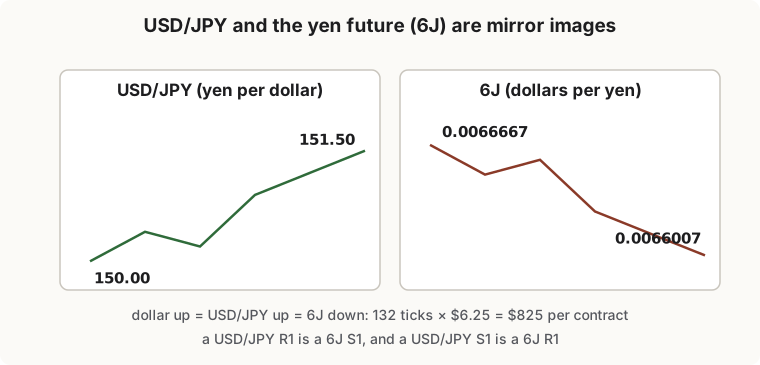
Example: USD/JPY rises from 150.00 to 151.50. 6J falls from 0.0066667 to 0.0066007, a fall of 0.0000660 = 132 ticks. A short 6J gains 132 × $6.25 = $825; a long loses $825.
The same mirror applies to the ladder: the high of a USD/JPY box is the low of the matching 6J box. A bullish reading on USD/JPY is a bearish reading on 6J.
Treasury futures (ZN and ZB)
| 10-Year T-Note (ZN) | U.S. Treasury Bond (ZB) | |
|---|---|---|
| Face value | $100,000 | $100,000 |
| Quote | Points and 32nds | Points and 32nds |
| Tick | ½ of 1/32 = $15.625 | 1/32 = $31.25 |
| One full point | $1,000 | $1,000 |
Reading the quote: 112’16 means 112 + 16/32 = 112.50. Platforms often show half-ticks with a third digit: 112’165 means 112 and 16.5/32.
Price and yield move in opposite directions. A bond pays fixed interest, so when market yields rise, existing bonds (and their futures) are worth less. If you expect yields to rise, you sell ZN; if you expect them to fall, you buy.
What moves them: Federal Reserve decisions and speeches, inflation reports (CPI), the jobs report, Treasury auctions, and flights to safety in a stock market sell-off (which push Treasury prices up).
Treasury futures are physically delivered (the short chooses which eligible Treasury notes to deliver). Trading moves to the next quarterly contract before the delivery month begins; roll before your broker’s deadline.
2 Check yourself
7 questions. Pass mark 70%. Retake as often as you like; your best score counts.