Calls, Puts and the Contract
1 Read
Read the class below, including each diagram, then tick the box.
This course is free to read. Sign in to tick off each class, take the quizzes and earn the certificate.
What you will be able to do
- Say what a call and a put give the buyer, and what they demand of the seller.
- Name the five terms that define every listed option.
- Turn a quoted premium into dollars, and read a line of an option chain: bid, ask, volume and open interest.
- Tell whether an option is in, at or out of the money.
A right with a deadline
An option is a contract between two people. The buyer pays money up front and gets a right. The seller (also called the writer) receives that money and takes on an obligation.
There are only two kinds:
- A call gives the buyer the right to buy 100 shares at a fixed price, until a fixed date.
- A put gives the buyer the right to sell 100 shares at a fixed price, until a fixed date.
The buyer never has to use the right. If using it would lose money, the buyer simply lets the option expire. The seller has no choice: if the buyer uses the right, the seller must deliver.
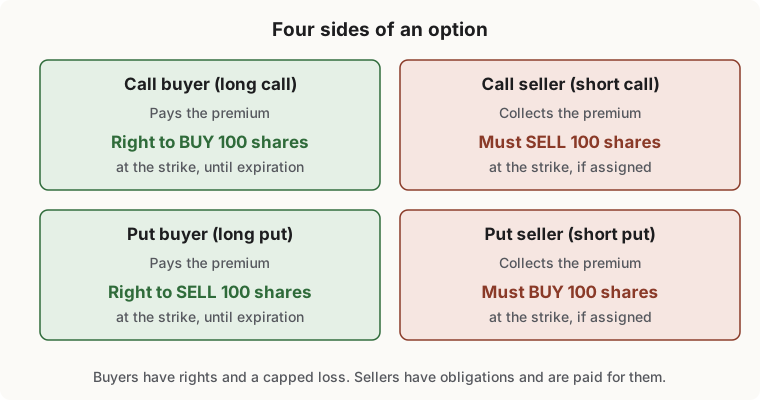
That gives four basic positions, and every strategy in this course is built from them:
| Position | Pays or receives | Wants the stock to | Risk |
|---|---|---|---|
| Long call (buy a call) | Pays premium | Rise | Limited to the premium |
| Long put (buy a put) | Pays premium | Fall | Limited to the premium |
| Short call (sell a call) | Receives premium | Stay below the strike | Unlimited if the call is not covered |
| Short put (sell a put) | Receives premium | Stay above the strike | Large: the stock can fall to zero |
Long means you bought the option; short means you sold it. The words describe the option, not the stock. A long put is a bet that the stock falls.
The five terms of every contract
Exchange-listed options are standardized: every contract on the same stock with the same terms is identical, which is what lets thousands of people trade them. Five terms define a contract.
- Underlying. The stock, ETF or index the option is on: XYZ, SPY, the S&P 500 index (SPX).
- Type. Call or put.
- Strike price. The fixed price at which the stock can be bought (call) or sold (put). Strikes are listed in steps, such as every $1, $2.50 or $5, depending on the stock’s price and how actively it trades.
- Expiration date. The last day the right exists. The standard monthly expiration is the third Friday of the month. Many stocks and ETFs also have weekly expirations, and the most active index products, such as SPX, have expirations every trading day.
- Style. An American-style option can be exercised on any business day up to expiration; almost all U.S. stock and ETF options are American. A European-style option can be exercised only at expiration; most cash-settled index options, including SPX, are European.
One more term is fixed by the exchange rather than chosen: the multiplier. A standard U.S. stock option covers 100 shares.
The premium, and the 100-share multiplier
The price of an option is called the premium, and it is quoted per share. To get the cost of one contract, multiply by 100.
cost of one contract = premium × 100
If the XYZ November 105 call is quoted at 1.66, one contract costs 1.66 × 100 = $166, plus commission. Five contracts cost $830 and give the right to buy 500 shares.
This is the most common beginner mistake in options: reading “1.66” as $1.66. It is $166 a contract. Always multiply by 100 before you decide whether you can afford the trade or the loss.
How a contract is named
Brokers show the same contract in a readable form and in a standard code.
- Readable: XYZ 20 NOV 26 105 CALL, or on many platforms XYZ Nov 20 ’26 105 C.
- OCC code: XYZ261120C00105000. Read it in parts: XYZ (underlying), 261120 (year 2026, month 11, day 20), C (call), 00105000 (the strike × 1,000, so 105.000).
You do not need to type the code, but recognizing it lets you check that a ticket, a statement or a confirmation shows the contract you meant.
Reading an option chain
An option chain lists every strike for one expiration, calls on one side and puts on the other. Here is part of the chain for our imaginary stock, XYZ, at $100.00, for the expiration 30 days away, November 20, 2026.
| Call bid | Call ask | Strike | Put bid | Put ask |
|---|---|---|---|---|
| 10.55 | 10.85 | 90 | 0.37 | 0.43 |
| 6.55 | 6.75 | 95 | 1.29 | 1.37 |
| 3.52 | 3.66 | 100 | 3.19 | 3.33 |
| 1.61 | 1.71 | 105 | 6.20 | 6.44 |
| 0.63 | 0.69 | 110 | 10.14 | 10.44 |
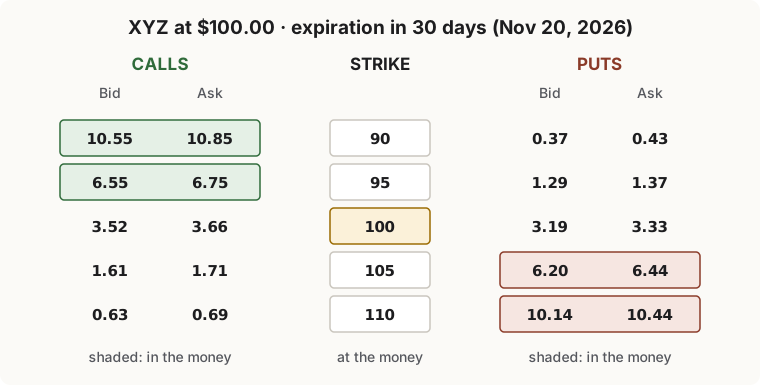
Read one line, the 105 call:
- Bid 1.61: the most anyone is offering to pay right now. If you sell at the market, you receive about $161 a contract.
- Ask 1.71: the lowest anyone is asking. If you buy at the market, you pay about $171.
- Mid 1.66: halfway between. A limit order near the mid often fills; Class 8 explains how to work it.
- Spread: 1.71 − 1.61 = 0.10, or $10 a contract. Like the spread in forex, you pay it on the way in and again on the way out.
Most chains also show:
- Volume: contracts traded today.
- Open interest: contracts that exist right now, opened and not yet closed. High open interest usually means tighter spreads and easier exits.
- Last: the price of the most recent trade, which can be hours old. Never price an order off “last”; use bid and ask.
In, at and out of the money
Moneyness compares the strike with the stock price. It tells you whether the option would be worth anything if it expired right now.
| Call | Put | |
|---|---|---|
| In the money (ITM) | Strike below the stock price | Strike above the stock price |
| At the money (ATM) | Strike at (or nearest to) the stock price | Same |
| Out of the money (OTM) | Strike above the stock price | Strike below the stock price |
With XYZ at $100: the 95 call is in the money by $5, because it lets you buy at $95 a stock worth $100. The 105 call is out of the money: nobody would use a right to pay $105 for a $100 stock. For puts it flips: the 105 put is in the money by $5, and the 95 put is out of the money.
An out-of-the-money option still has a price (the 105 call is 1.66), because there is time left for the stock to get there. Class 3 splits every premium into these two parts.
Exercise, assignment and settlement
- Exercise: the buyer uses the right. A call holder who exercises buys 100 shares at the strike; a put holder sells 100 shares at the strike.
- Assignment: the seller is chosen to fulfil an exercise. A short call that is assigned must sell 100 shares at the strike; a short put that is assigned must buy them.
- Stock options settle in shares (physical settlement). Index options such as SPX settle in cash: no shares change hands, and the difference between the strike and the settlement value is paid in dollars (× 100).
Most traders never exercise. They close the option instead, by selling the call or put they bought (or buying back the one they sold). Closing captures the option’s remaining time value, which exercising throws away. Class 8 covers this in detail.
Who is on the other side
When you buy an option, a seller receives your premium, but you never deal with that person. The Options Clearing Corporation (OCC) stands between every buyer and seller, so your contract does not depend on any one stranger keeping their word. When a buyer exercises, the OCC assigns the obligation to a broker, and the broker assigns it to one of its customers who is short that contract.
Getting approved
Brokers grade options accounts into approval levels. The names differ by firm, but they usually run like this:
- Covered calls and buying protective puts.
- Buying calls and puts; cash-secured puts.
- Spreads (defined-risk combinations).
- Selling options without cover (naked), which needs margin and experience.
Apply for the level that fits what you will actually trade. Everything in Classes 1 to 8 can be done with defined risk.
2 Check yourself
8 questions. Pass mark 70%. Retake as often as you like; your best score counts.