Payoffs at Expiration
1 Read
Read the class below, including each diagram, then tick the box.
This course is free to read. Sign in to tick off each class, take the quizzes and earn the certificate.
What you will be able to do
- Work out what any call or put is worth at expiration.
- Find the breakeven, maximum gain and maximum loss of the four basic positions.
- Draw a payoff diagram and read it.
- Compare a call with owning the shares, in dollars and in percent.
At expiration, only one thing matters
Before expiration, an option’s price depends on many things (Class 3). At expiration it depends on one: where the stock is compared with the strike. Whatever time value was left is gone, and the option is worth exactly its intrinsic value:
call at expiration = stock price − strike, or zero if that is negative
put at expiration = strike − stock price, or zero if that is negative
With XYZ at $112 at expiration, the 105 call is worth 112 − 105 = $7 (×100 = $700). The 105 put is worth zero. With XYZ at $98, the 105 call is worth zero and the 105 put is worth 105 − 98 = $7.
Profit or loss is that value minus what you paid (or, for a seller, what you collected minus that value).
The long call
You buy the XYZ November 105 call for 1.66 ($166).
| XYZ at expiration | Call worth | Profit or loss |
|---|---|---|
| $95 | 0 | −$166 |
| $100 | 0 | −$166 |
| $105 | 0 | −$166 |
| $106.66 | 1.66 | $0 (breakeven) |
| $110 | 5.00 | +$334 |
| $115 | 10.00 | +$834 |
| $120 | 15.00 | +$1,334 |
- Maximum loss: the premium, $166, whenever XYZ finishes at or below 105.
- Breakeven: strike + premium = 105 + 1.66 = $106.66.
- Maximum gain: unlimited. Every dollar above the breakeven is $100 of profit per contract.
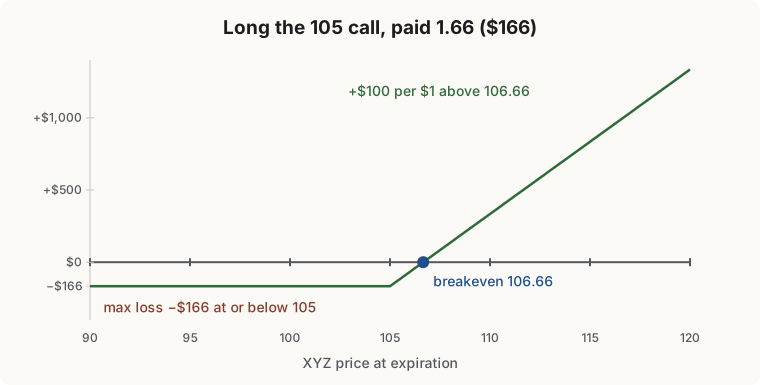
Notice what the call needs: XYZ has to rise more than 6.66% in 30 days just to break even. Buying options means you must be right about direction, size and timing all at once. That is why most out-of-the-money options bought by the public expire worthless, and why Class 6 spends so much time on choosing strikes.
The long put
You buy the XYZ November 95 put for 1.33 ($133).
- Maximum loss: the premium, $133, whenever XYZ finishes at or above 95.
- Breakeven: strike − premium = 95 − 1.33 = $93.67.
- Maximum gain: large but limited, because a stock cannot fall below zero: (95 − 1.33) × 100 = $9,367 if XYZ went to zero.
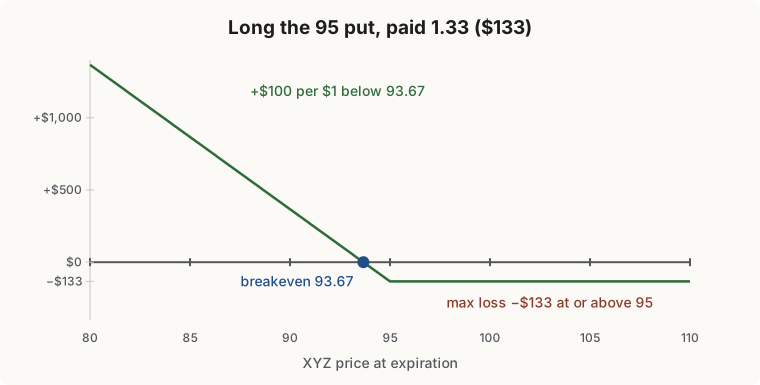
A long put is the simplest way to profit from a fall with a fixed, known risk. It is also the simplest insurance: if you own 100 shares of XYZ, a 95 put guarantees you can sell them at $95 until November 20, whatever happens. That is the protective put in Class 6.
The short put
Now take the other side. You sell the 95 put and collect 1.33 ($133).
- Maximum gain: the premium, $133, whenever XYZ finishes at or above 95.
- Breakeven: 95 − 1.33 = $93.67, the same point as the buyer’s.
- Maximum loss: large: if XYZ went to zero you would have to buy shares at $95 that are worth nothing, a loss of (95 − 1.33) × 100 = $9,367.
The short put is the mirror image of the long put. Every dollar one side makes, the other side loses. The seller is paid to take on the risk the buyer wants to give away, and wins more often but in smaller amounts. Class 7 shows how sellers use this, and how to cap the loss.
The short call
You sell the 105 call and collect 1.66 ($166).
- Maximum gain: $166, whenever XYZ finishes at or below 105.
- Breakeven: 105 + 1.66 = $106.66.
- Maximum loss: unlimited, if you do not own the shares. At $130, the call is worth $25, so you lose $2,500 − $166 = $2,334, and nothing stops the stock at $130.
If you do own 100 shares, the short call is covered: if you are assigned, you hand over the shares you already have. That is the covered call in Class 7, and it is one of the most common option positions there is.
The four positions together
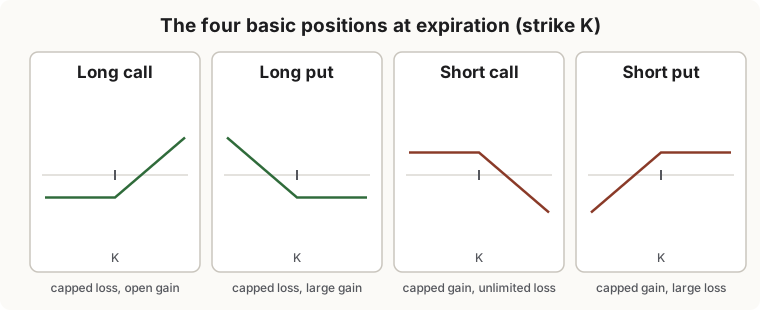
| Long call | Long put | Short call | Short put | |
|---|---|---|---|---|
| Breakeven | strike + premium | strike − premium | strike + premium | strike − premium |
| Max gain | Unlimited | strike − premium (× 100) | Premium | Premium |
| Max loss | Premium | Premium | Unlimited | strike − premium (× 100) |
| Wins if XYZ | Rises past breakeven | Falls past breakeven | Stays below breakeven | Stays above breakeven |
Memorize the two breakeven rules. Calls: strike plus premium. Puts: strike minus premium. Every later strategy is a combination of these lines, and its breakevens come from the same arithmetic.
A call against the shares
Why buy a call instead of the stock? Compare $10,000 of XYZ shares with one 105 call, if XYZ rises to $115 by expiration.
| 100 shares at $100 | One 105 call at 1.66 | |
|---|---|---|
| Money put in | $10,000 | $166 |
| Value at $115 | $11,500 | $1,000 |
| Profit | +$1,500 | +$834 |
| Return on money put in | +15% | +502% |
| If XYZ is at $100 instead | $0 | −$166 (−100%) |
| If XYZ falls to $90 | −$1,000 (−10%) | −$166 (−100%) |
The call gives leverage: a far larger percentage return for a far smaller outlay, with a fixed maximum loss. The cost is that if the stock goes nowhere, the shareholder loses nothing and the call buyer loses everything. A flat market is a loss for an option buyer.
That trade-off is the whole personality of options. Buyers pay for leverage and a capped risk, and lose to time. Sellers collect for taking the risk, and win from time. Every strategy chooses where it sits between the two.
Percent returns can mislead
A +502% return sounds wonderful, but it came from a $166 position. Judge an options trade by dollars at risk and by the chance of the outcome, not by percent. A 30-day 105 call on a $100 stock with these volatility assumptions finishes in the money only about 28% of the time (Class 4 explains where that number comes from), and above the 106.66 breakeven even less often.
2 Check yourself
7 questions. Pass mark 70%. Retake as often as you like; your best score counts.