What Sets an Option's Price
1 Read
Read the class below, including each diagram, then tick the box.
This course is free to read. Sign in to tick off each class, take the quizzes and earn the certificate.
What you will be able to do
- Split any premium into intrinsic value and time value.
- Name the six inputs to an option’s price and say which way each one pushes calls and puts.
- Explain why time decay accelerates in the last weeks.
- Check that a call and a put on the same strike are priced consistently.
Two parts of every premium
Every option price is made of two parts:
premium = intrinsic value + time value
- Intrinsic value is what the option would be worth if it expired right now (Class 2): for a call, stock − strike; for a put, strike − stock; never less than zero.
- Time value (also called extrinsic value) is everything else: what buyers pay for the chance that the option becomes worth more before it expires.
Here is the XYZ chain from Class 1, at mid prices, split into its two parts. XYZ is at $100, with 30 days to go.
| Strike | Call | Intrinsic | Time value | Put | Intrinsic | Time value |
|---|---|---|---|---|---|---|
| 90 | 10.70 | 10.00 | 0.70 | 0.40 | 0 | 0.40 |
| 95 | 6.65 | 5.00 | 1.65 | 1.33 | 0 | 1.33 |
| 100 | 3.59 | 0 | 3.59 | 3.26 | 0 | 3.26 |
| 105 | 1.66 | 0 | 1.66 | 6.32 | 5.00 | 1.32 |
| 110 | 0.66 | 0 | 0.66 | 10.29 | 10.00 | 0.29 |
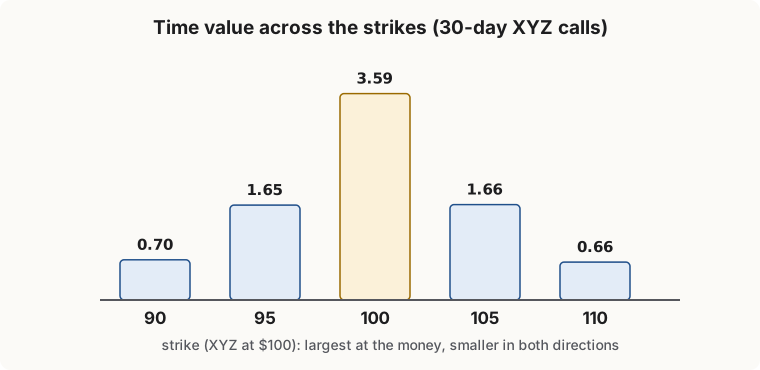
Two things to see:
- Time value is largest at the money. That is where the outcome is most uncertain, so the chance of a change is worth the most.
- Out-of-the-money options are pure time value. Every cent of the 105 call’s 1.66 will be gone at expiration unless XYZ rises above 105.
Time value is what option buyers pay and what option sellers collect. Almost every strategy decision comes down to whether you want to own it or sell it.
The six inputs
Six things set an option’s price. Professional pricing models, such as the Black-Scholes model and its relatives, are formulas that combine them; you do not need the formula, but you do need to know which way each input pushes the price.
| Input rises → | Call price | Put price | Why |
|---|---|---|---|
| 1. Stock price | ↑ | ↓ | The call is closer to (or deeper in) the money |
| 2. Strike price (choosing a higher one) | ↓ | ↑ | A higher strike costs a call buyer more to use |
| 3. Time to expiration | ↑ | ↑ | More time, more chance of a big move |
| 4. Volatility | ↑ | ↑ | A wider range of possible prices helps the buyer, whose loss is capped |
| 5. Interest rates | ↑ (slightly) | ↓ (slightly) | Buying the call instead of the stock leaves cash earning interest |
| 6. Dividends expected before expiration | ↓ | ↑ | The stock drops by the dividend on the ex-date |
The stock price, the strike and the time left are known exactly. Interest rates and dividends move slowly. Volatility is the only input nobody knows, which is why it gets its own class (Class 5). The market’s guess of future volatility, worked backward out of option prices, is called implied volatility.
Time decay speeds up
Time value shrinks every day, but not evenly. Here is the at-the-money XYZ 100 call, with the stock held at $100 and volatility unchanged, as expiration comes closer:
| Days left | 90 | 60 | 45 | 30 | 21 | 14 | 7 | 3 | 1 |
|---|---|---|---|---|---|---|---|---|---|
| Call price | 6.41 | 5.17 | 4.44 | 3.59 | 2.98 | 2.42 | 1.70 | 1.10 | 0.63 |
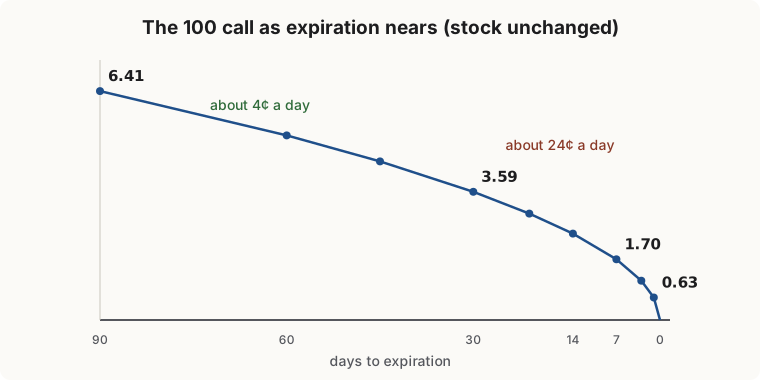
- From 90 to 60 days, the call loses 1.24 in 30 days: about 4 cents a day.
- From 30 to 21 days, it loses 0.61 in 9 days: about 7 cents a day.
- In the last 7 days, it loses 1.70: about 24 cents a day.
Time value decays roughly with the square root of the time left, so the last weeks melt fastest. This one curve explains two habits you will see in later classes:
- Buyers usually choose more time than they think they need (often 45 to 90 days or more) and sell before the last few weeks, so the steep part of the curve works against someone else.
- Sellers often sell around 30 to 45 days out, to collect the faster part of the decay without holding into the riskiest final days.
Volatility raises premiums
Hold everything else fixed and change only the implied volatility of the 30-day XYZ 100 call:
| Implied volatility | 20% | 30% | 40% |
|---|---|---|---|
| 100 call price | 2.45 | 3.59 | 4.73 |
Ten points of volatility moved the price by about 1.14, or $114 a contract, with the stock not moving at all. An option can lose money on a correct direction call if volatility falls at the same time. Class 5 shows where this hurts most: right after earnings.
Put-call parity: the call and put are linked
A call and a put with the same strike and expiration are tied together by arbitrage. For a stock that pays no dividend before expiration:
call − put = stock − strike × (discount for interest)
The discount is small for short-dated options. For the XYZ 100 strike, 30 days, at 4% interest: 100 × e^(−0.04 × 30/365) ≈ 99.67.
- Left side: 3.59 − 3.26 = 0.33
- Right side: 100 − 99.67 = 0.33
If the two sides drifted apart, traders could buy the cheap side, sell the expensive side and lock in a riskless profit, so they stay together. You will use parity in two practical ways:
- A sanity check. If a call looks cheap but the put on the same strike is just as “cheap”, the market is telling you something (usually a dividend or a hard-to-borrow stock), not handing you a bargain.
- Synthetic positions. Long call + short put at the same strike behaves like owning 100 shares. That is why a short put is often described as “a bullish trade”, and why covered calls and short puts have the same shape (Class 7).
A worked example
XYZ moves from $100 to $103 two weeks later (16 days left), and implied volatility is unchanged at 30%. What happens to the 105 call bought at 1.66?
- The stock rose 3%, which helps.
- 14 days of decay passed, which hurts.
- The calculated price is now about 1.80: a gain of only 0.14, or $14 a contract, on a move that took the stock most of the way to the strike.
If instead XYZ had gone to $103 in two days (28 days left), the call would be worth about 2.67, a gain of $101: the same move, about seven times the profit. For a buyer, when the stock moves matters as much as how far.
2 Check yourself
7 questions. Pass mark 70%. Retake as often as you like; your best score counts.