The Greeks
1 Read
Read the class below, including each diagram, then tick the box.
This course is free to read. Sign in to tick off each class, take the quizzes and earn the certificate.
What you will be able to do
- Use delta to estimate how much an option gains or loses when the stock moves, and how many shares it behaves like.
- Use gamma to see how fast delta changes, and why that matters near expiration.
- Use theta to know what time costs you, or pays you, each day.
- Use vega to see how much a change in volatility moves the price.
- Add the Greeks across a position with several legs.
Why “Greeks”
Class 3 listed the inputs to an option’s price. The Greeks measure how much the price changes when one input changes and the others stay put. Each is named after a Greek letter (vega is the exception; it just sounds Greek). Every broker platform shows them next to the chain, so you never need to calculate them. You need to read them.
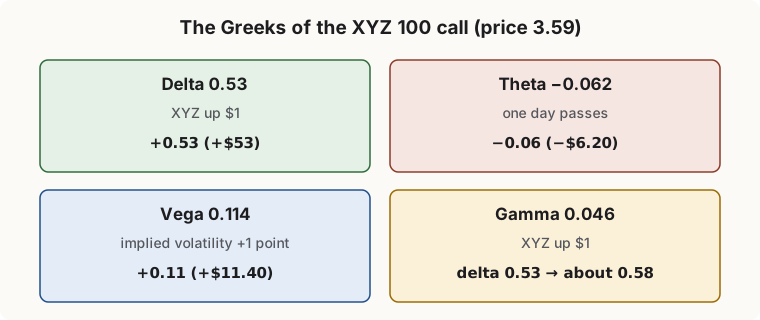
All the examples use the XYZ November 100 call: XYZ at $100, 30 days left, implied volatility 30%, price 3.59.
| Greek | Value | Means, per contract |
|---|---|---|
| Delta | 0.53 | +$53 if XYZ rises $1 |
| Gamma | 0.046 | Delta rises by 0.046 for each $1 XYZ rises |
| Theta | −0.062 | −$6.20 a day from time passing |
| Vega | 0.114 | +$11.40 for each 1 point rise in implied volatility |
Delta: the stock-move Greek
Delta is how much the option’s price changes for a $1 move in the stock.
- Calls have delta between 0 and +1. Puts have delta between 0 and −1.
- At the money, delta is near ±0.50. Deep in the money it approaches ±1; far out of the money it approaches 0.
Check it: XYZ rises from $100 to $101. The 100 call should rise by about 0.53, from 3.59 to about 4.12. The model price at $101 is 4.15; the extra 3 cents is gamma at work (below).
Delta has three practical meanings:
- Price sensitivity. Delta × $1 move × 100 = dollars per contract.
- Share equivalent. A delta of 0.53 means one call behaves, for small moves, like owning 53 shares. Ten of them behave like 530 shares. This is how you compare an option position with a stock position of the same risk.
- A rough probability. Delta is close to the market’s estimate of the chance the option finishes in the money. The XYZ 105 call has a delta of 0.31, and the model’s probability of finishing above 105 is about 28%. Traders use delta as a quick gauge: “a 30-delta call” is roughly a 30% shot.
The delta of each strike in the 30-day XYZ chain:
| Strike | 90 | 95 | 100 | 105 | 110 |
|---|---|---|---|---|---|
| Call delta | 0.90 | 0.75 | 0.53 | 0.31 | 0.15 |
| Put delta | −0.10 | −0.25 | −0.47 | −0.69 | −0.85 |
The call delta minus the put delta on the same strike is always about 1 (0.53 − (−0.47) = 1.00). That is put-call parity again: long call + short put = 100 shares, delta 1.
Gamma: how fast delta changes
Gamma is how much delta changes for a $1 move in the stock. The 100 call’s gamma is 0.046, so after XYZ rises $1 its delta is about 0.53 + 0.05 = 0.58. The next dollar up earns more than the first.
- Gamma is largest at the money and near expiration. The same 100 call with 7 days left has a gamma of 0.096, twice as large: its delta swings from near 0 to near 1 over a small move.
- Buyers have positive gamma: their deltas grow when the stock moves their way and shrink when it moves against them. That is the capped-loss, open-gain shape from Class 2.
- Sellers have negative gamma: their position gets worse faster as the stock moves against them. A short at-the-money option a few days before expiration can swing from a small profit to a large loss in one afternoon. This is the main reason sellers close or roll positions before the final week.
Theta: what time costs
Theta is the change in price from one day passing, everything else unchanged. The 100 call’s theta is −0.062: it loses about $6.20 a day per contract. Check it: with 29 days left and nothing else changed, the call is worth 3.53, six cents less.
- Long options have negative theta: time costs you money every day.
- Short options have positive theta: time pays you.
- Theta grows near expiration (the curve in Class 3). The 7-day at-the-money call loses about $12 a day, twice the 30-day rate.
Theta and gamma are two sides of one bargain. A buyer pays theta every day for gamma: the chance of a big move. A seller collects theta for taking gamma’s risk. You cannot have positive gamma and positive theta in the same simple position.
Vega: the volatility Greek
Vega is the change in price for a 1-point change in implied volatility. The 100 call’s vega is 0.114: if implied volatility rises from 30% to 31%, the call gains about $11.40 a contract (the model gives 3.71, up 0.12).
- Long options have positive vega: they gain when volatility rises.
- Short options have negative vega.
- Vega is larger for longer-dated options. The 60-day 105 call has a vega of 0.155 against 0.102 for the 30-day one, because a volatility change matters over more days.
A 10-point drop in volatility costs the 100 call about $114, more than 18 days of theta. Class 5 shows when such drops happen.
Rho
Rho is the change in price for a 1-point change in interest rates. It is small for options of a few weeks and matters mainly for long-dated options (LEAPS) and in periods when rates move quickly. Calls have positive rho, puts negative. Most short-term traders can note it and move on.
Adding the Greeks across a position
Greeks add up. For each leg, multiply the Greek by the number of contracts, with a minus sign for short legs, and add the legs. Multiply by 100 to get dollars or shares.
Example: long 2 XYZ 105 calls and short 1 XYZ 95 put (a bullish position).
| Leg | Delta | Theta | Vega |
|---|---|---|---|
| +2 × 10⁵ call | +2 × 0.31 = +0.62 | +2 × −0.054 = −0.108 | +2 × 0.102 = +0.204 |
| −1 × 95 put | −1 × −0.25 = +0.25 | −1 × −0.043 = +0.043 | −1 × 0.091 = −0.091 |
| Position | +0.87 | −0.065 | +0.113 |
Read the position:
- Delta +0.87: it behaves like owning about 87 shares of XYZ.
- Theta −0.065: time costs it about $6.50 a day.
- Vega +0.113: it gains about $11.30 for each point implied volatility rises.
This is how professionals think about a book of options: not as separate trades but as total exposure to the stock, to time and to volatility. Your platform’s position page will show these totals; check them before you add to a position.
What the Greeks cannot do
- They are snapshots. Every Greek changes as the stock, time and volatility change. A delta of 0.53 now will be different tomorrow.
- They are small-move estimates. For a large move, gamma makes delta’s estimate too small for buyers and too optimistic for sellers. Use the platform’s risk graph (profit and loss across a range of prices) for big moves.
- They come from a model. If the model’s assumptions are wrong (a takeover, an earnings gap), the Greeks will be wrong too.
2 Check yourself
7 questions. Pass mark 70%. Retake as often as you like; your best score counts.