Options Through the Outer Box
1 Read
Read the class below, including each diagram, then tick the box.
This course is free to read. Sign in to tick off each class, take the quizzes and earn the certificate.
What you will be able to do
- Turn an Outer Box reading into an options trade, with every part stated as a level.
- Match the expiration to the box whose levels you are trading.
- Put a debit spread’s short strike at the ladder target.
- Put a credit spread’s short strike beyond the level that would prove the reading wrong.
- Place an iron condor’s short strikes outside the outer thresholds, and compare them with the expected move.
- Exit on the underlying’s price, and size by how many boxes agree.
A quick reminder of the ladder
The Outer Box draws a completed period’s high (R1) and low (S1) and divides the range into levels. With XYZ’s September box running from $94.00 to $106.00 (a range of $12), the monthly ladder for October is:
| Level | % of range | XYZ | What it is |
|---|---|---|---|
| R2 | 150% | 112.00 | First breakout target |
| 110% | 110% | 107.20 | Outer threshold: a close above confirms the breakout |
| R1 | 100% | 106.00 | High of the box |
| RX | 90% | 104.80 | Falling back below fires the bearish sentiment trigger |
| C | 50% | 100.00 | Center: above C bullish, below bearish |
| SX | 10% | 95.20 | Rising back above fires the bullish sentiment trigger |
| S1 | 0% | 94.00 | Low of the box |
| −10% | −10% | 92.80 | Outer threshold: a close below confirms the breakdown |
| S2 | −50% | 88.00 | First breakdown target |
Chapter 21 of the book turns a reading into a trade with one rule: every part of the trade is a level on the ladder. Entry at a sentiment trigger in the direction the direction box favours; stop beyond the threshold that would make the reading wrong; target at the next level; size by how many boxes agree. Options add one thing the ladder does not have, a deadline, and give new ways to express the same levels.
Rule 1: the expiration follows the box
An option needs the move to happen before it expires. The levels you trade come from a box, and a box has a period, so let the period set the expiration:
| Ladder you are trading | Typical expiration |
|---|---|
| Monthly box (targets C, the edge zone, R2) | 45 to 60 days, closed or rolled with about 21 days left |
| Weekly box | 2 to 4 weeks |
| Daily box | Avoid single options; the levels are too close for the time decay and spread. Use the stock, or a spread several days out |
Two cautions. The monthly options expiration is the third Friday, not the last day of the month, so it does not line up with the monthly box; choose an expiration that covers the time your target needs, not the calendar month. And remember that a box’s live levels move until the period closes (the chain reaction from Outer Box Foundations); trade off the completed box’s levels.
Rule 2: a debit spread aims its short strike at the target
The reading. XYZ tested S1 in early October, dipping to $94.60, and then rose back above SX at $95.20: a monthly bullish sentiment trigger. The yearly box is bullish (price above its C), and the daily boxes have started stepping up. XYZ is now $96.50. This is the book’s pullback trade: entry on the trigger, stop beyond −10%, first target C, then the edge zone.
As a bull call spread (45 days, implied volatility 30%): buy the 95 call at 5.07, sell the 100 call at 2.79.
Debit 2.28 ($228). Maximum gain (100 − 95) − 2.28 = 2.72 ($272) at or above C. Breakeven $97.28.
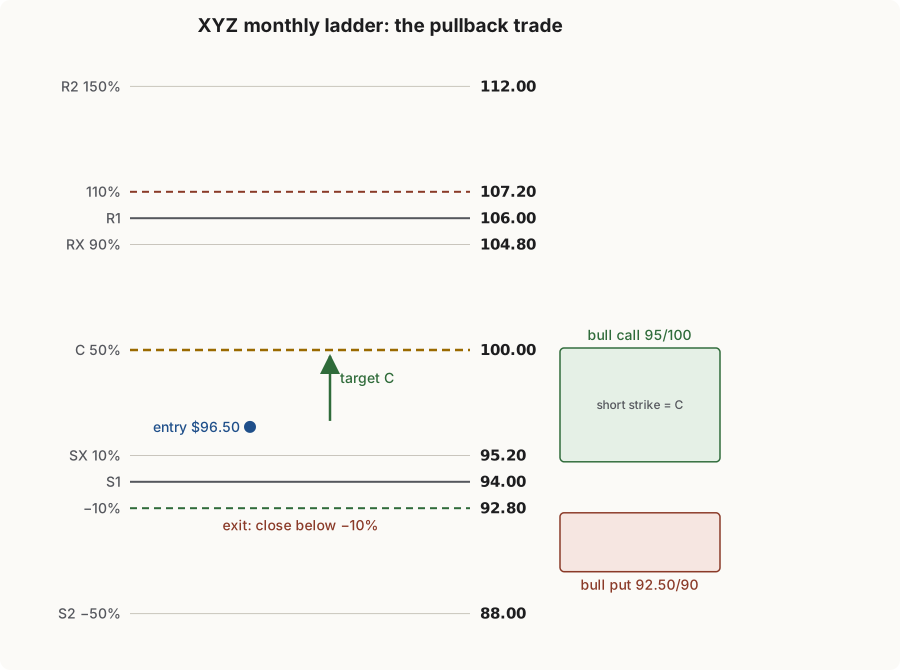
- The short strike is the target. You sell the part of the move beyond C that the reading does not expect, which pays for nearly half the call.
- If XYZ reaches C with 30 days left, the spread is worth about 3.06: a gain of $78. To collect the full $272, XYZ has to hold above C until expiration. That is the trade-off the book describes at C: take part of the profit there, and let the rest run with the exit moved up.
- To aim at the edge zone instead, use a wider spread with the short strike near RX (for example, buy the 95 call and sell the 105 call).
Rule 3: a credit spread hides its short strike beyond the invalidation
The same reading can be traded by selling premium. The reading is wrong if XYZ closes below −10% at $92.80, so put the short put just beyond that level, where a loss would mean the reading had already failed.
Bull put spread (45 days): sell the 92.50 put at 2.12, buy the 90 put at 1.38.
Credit 0.74 ($74). Maximum loss (92.50 − 90) − 0.74 = 1.76 ($176). Breakeven $91.76.
- The trade wins if XYZ simply stays above the invalidation level. It does not need C.
- The short strike’s delta is about −0.31, so the market gives it roughly a two-in-three chance of expiring worthless; your reading adds the box’s edge.
- If XYZ does close below $92.80, close the spread. With 35 days left the model values it at about 1.07: a loss of $33, far less than the $176 maximum, because you exited when the reading failed instead of waiting for expiration.
This is the most natural way to trade the ladder with options: the level that would prove you wrong becomes the strike you sell.
Rule 4: exits are levels on the underlying
An option’s price is not on the ladder; XYZ’s is. So state every exit in XYZ dollars, and use your platform’s orders or alerts triggered by the stock price (Class 8):
- Invalidation: close the whole position on a daily close beyond the threshold (here, below $92.80).
- Targets: close part at C, review at the edge zone (RX to R1). At the edge zone the top-of-box rules take over: a rejection is an exit, a failed rejection and a close above 110% is a hold for R2.
- Trail by levels: once XYZ is above C, the level that would make the reading wrong is higher. Move the exit up to a close below SX.
- Time: close or roll with about 21 days left, whatever the levels say.
Rule 5: breakouts use the outer threshold, and R2 as the target
The reading. Later in the month XYZ closes above 110% at $107.20, confirming the monthly breakout, with the weekly boxes stepping up. XYZ is $107.50. This is the book’s trend trade: stop beyond the threshold that was cleared, targets R2 then R3.
Bull call spread (30 days): buy the 108 call at 3.62, sell the 112 call at 2.05.
Debit 1.57 ($157). Maximum gain (112 − 108) − 1.57 = 2.43 ($243) at or above R2. Breakeven $109.57. Exit on a close back below $107.20.
The short strike sits at R2, where the book expects a strong breakout to consolidate.
Rule 6: condors live outside the outer thresholds
When XYZ is back at C with no trigger fired, the book’s directional rules say no trade: there is no edge in the body of the range. But the box still says something useful: the market has to clear an outer threshold before a real breakout or breakdown is confirmed. An iron condor can be placed so that it only loses if one of those happens.
XYZ at $100, 30 days: sell the 92.50 put (0.76) and the 107.50 call (1.06); buy the 87.50 put (0.19) and the 112.50 call (0.39).
Credit 1.24 ($124). Maximum loss 5 − 1.24 = 3.76 ($376). Breakevens $91.26 and $108.74.
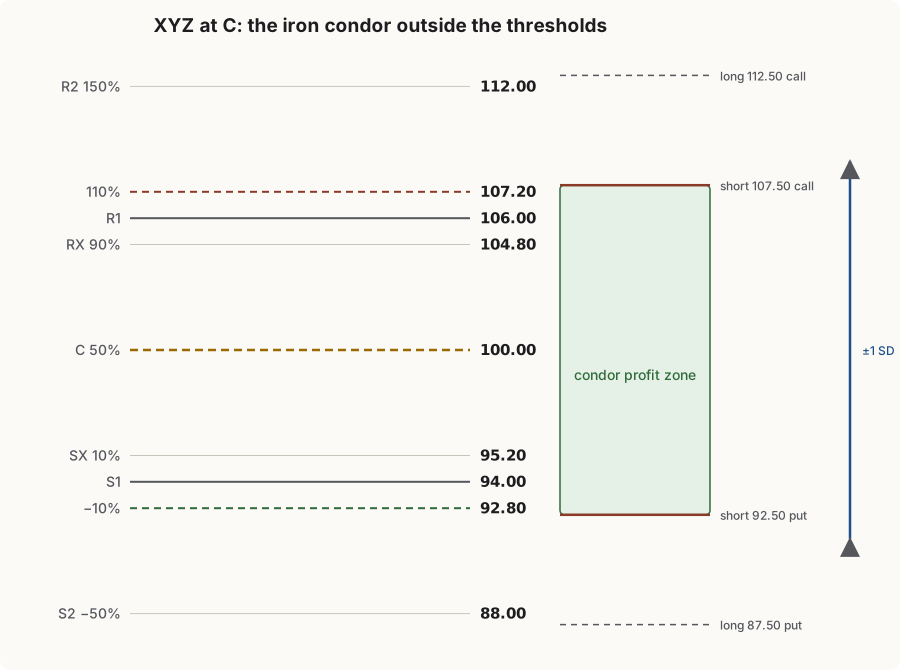
Compare three ranges:
| Low | High | |
|---|---|---|
| Outer thresholds (−10%, 110%) | 92.80 | 107.20 |
| Condor short strikes | 92.50 | 107.50 |
| Expected move, 1 standard deviation (Class 5) | 91.40 | 108.60 |
Here the box and the options market agree: the range the box defends is about the range the market expects. When the expected move is much wider than the box’s thresholds, the market is pricing a breakout-sized move; a condor inside the box is then selling too little room. When it is narrower, options are cheap relative to the box, and buying spreads toward R2 or S2 may be the better trade.
Close the condor on a daily close beyond either threshold. That close is the box telling you the range has failed.
Rule 7: size by alignment
Chapter 21 sizes by how many boxes agree, and the site’s Target Grader turns that into a grade. Combine it with the maximum-loss sizing from Class 9:
| Alignment | Target Grader grade | Size |
|---|---|---|
| All boxes agree | Strong | Full: your full risk per trade, by maximum loss |
| Direction box and trading box agree, one box against | Moderate | Full at a large-box level, otherwise reduced |
| Trading box against the direction box (a counter-trend trade) | Weak | Reduced (for example half), target C only |
| Nothing fired | — | No directional trade |
With a $25,000 account risking 1% ($250), a Strong pullback trade could be one bull call spread ($228) or one 92.50/90 bull put spread ($176). A Weak reading would be half that risk: smaller spreads, or none.
Putting it together: the options checklist for a ladder trade
- Reading: direction box, state box, trading box; which trigger fired; which trade shape (pullback, trend, failed rejection, counter-trend).
- Levels: entry, invalidation (beyond the threshold), first and second target, all in the underlying’s price.
- Expiration: from the box’s period (Rule 1).
- Structure: debit spread with its short strike at the target, or credit spread with its short strike beyond the invalidation, or no trade.
- Volatility: IV rank and the expected move. Is the market already pricing your move?
- Size: maximum loss, by alignment and your risk per trade.
- Exits: stock-price alerts at the invalidation and targets; the 21-day time stop.
2 Check yourself
8 questions. Pass mark 70%. Retake as often as you like; your best score counts.