Risk, Sizing and the Options Plan
1 Read
Read the class below, including each diagram, then tick the box.
This course is free to read. Sign in to tick off each class, take the quizzes and earn the certificate.
What you will be able to do
- Work out how many contracts or spreads to trade from your account size and risk per trade.
- Limit total exposure across all open positions: risk, delta, volatility and events.
- Check whether a strategy can make money over many trades, using expectancy.
- Run a pre-trade checklist and keep an options journal.
- Write a one-page options trading plan.
Size by the loss, not by the premium
Risk and Money Management set the rule: decide the most you will lose on one trade, as a percentage of the account, before you decide the size. Options make the arithmetic easy, because many positions have a known maximum loss.
number of contracts = money you will risk ÷ loss per contract
Example account: $25,000, risking 1% per trade = $250.
| Trade | Loss per contract (or spread) | Contracts | Money at risk |
|---|---|---|---|
| Bull call spread 100/105, debit 1.93 | $193 (maximum) | 1 | $193 |
| Bear call spread 105/110, credit 1.00 | $400 (maximum) | 0 at 1%: too big | — |
| Bear call spread 105/107.50, credit 0.60 | $190 (maximum) | 1 | $190 |
| Long 105 call at 1.66, closed if it halves | $83 planned, $166 if it gaps | 2 to 3 | $166 to $249 planned |
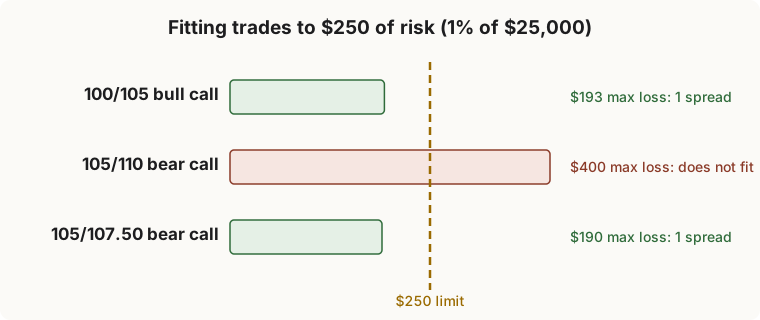
Three rules come out of this table:
- Use the maximum loss for defined-risk trades. A credit spread’s maximum loss happens, usually on a gap. Size as if it will.
- If a trade does not fit, change the trade, not the rule. Narrow the spread (2.50 wide instead of 5), choose a cheaper structure, or skip it. Never stretch the risk because the setup “looks good”.
- For single long options, decide whether you size by the full premium or a planned exit. Sizing by the full premium is safer; sizing by a planned exit (close at −50%) allows more contracts but assumes you will get out, and options gap.
Undefined-risk positions (naked short calls and puts, short straddles) have no fixed maximum. Size them by a stress test: what would this position lose on a gap of two or three expected moves, or a 20% overnight drop? If that number is larger than you can accept, the position is too big. Most traders with accounts under six figures are better served by defined-risk spreads.
Limits on the whole account
One position sized correctly does not make a safe account. Add limits across everything that is open:
- Total risk: the sum of the maximum losses of all open positions, for example no more than 5% to 6% of the account.
- Direction: the total position delta (Class 4). If ten bullish spreads add up to a delta of +600, you effectively own 600 shares’ worth of market risk. Know that number.
- Volatility: the total vega. A book of short premium can lose on every position at once when implied volatility jumps.
- Concentration: several positions on related stocks (five chip makers, three banks) behave like one larger position.
- Events: know which open positions span an earnings date, a Federal Reserve decision or a major economic release, and reduce or close the ones you do not want exposed.
Expectancy: can the strategy make money at all?
A strategy’s expectancy is the average profit or loss per trade over many trades:
expectancy = (win rate × average win) − (loss rate × average loss)
Take the bull put spread from Class 7: credit $93, maximum loss $407. Suppose you close winners at 50% of the credit (+$46) and close losers when the spread doubles in price (a loss of about $93), and the result is a 75% win rate:
0.75 × $46 − 0.25 × $93 = $34.50 − $23.25 = +$11.25 per trade, before commissions.
Now suppose you hold losers to expiration instead and lose the full $407 a quarter of the time:
0.75 × $46 − 0.25 × $407 = $34.50 − $101.75 = −$67.25 per trade.
Same entries, same win rate: one set of exit rules makes money and the other loses it steadily. For premium sellers, the loss rule is the strategy. Track your real win rate and average win and loss in your journal; your own numbers, not anyone’s marketing, tell you whether a strategy works for you.
The breakeven win rate for a strategy is:
average loss ÷ (average win + average loss)
For the managed spread: 93 ÷ (46 + 93) = 67%. If your real win rate falls below that over a meaningful sample, the strategy is losing money.
The pre-trade checklist
Before every options trade, answer each line:
- Idea: direction, target and time frame, in writing.
- Volatility: IV and IV rank. Am I buying cheap or selling expensive (Class 5)?
- Events: earnings, dividends, economic releases before expiration?
- Structure: why this strategy, strike and expiration fit the idea.
- Liquidity: open interest and a bid-ask spread under about 10% of the price.
- Numbers: maximum loss, maximum gain, breakeven(s).
- Size: contracts from the formula; total account risk still inside the limit.
- Exits: profit target, loss rule, time stop.
- Order: limit price at or near the mid; spread entered as one order.
The options journal
Record, for every trade:
| Field | Example |
|---|---|
| Date, underlying, price | Oct 21, XYZ, $100.00 |
| Strategy and legs | Bull call spread: +100C / −105C, Nov 20 |
| Entry price | 1.93 debit |
| IV and IV rank at entry | 30%, 38 |
| Reason | Daily box stepping up, price above C (see Class 10) |
| Maximum loss and gain | $193 / $307 |
| Exit rules | Close at 3.00 or at 0.95, or with 21 days left |
| Exit date and price | Nov 4, 2.90 |
| Result and lesson | +$97. Took profit near target; IV fell 3 points |
After 20 to 30 trades of one strategy, total the results: win rate, average win, average loss, expectancy. That is the only honest test of a strategy.
Common mistakes
- Buying cheap far-out-of-the-money options because they are cheap.
- Holding long options into the last two weeks, or through earnings, without meaning to.
- Selling premium with no loss rule, or rolling losers indefinitely.
- Sizing by how good the setup looks.
- Ignoring the bid-ask spread on illiquid strikes.
- Forgetting an in-the-money option at expiration and being exercised into shares.
- Treating a 0DTE trade as a small risk because the premium is small.
Your one-page options plan
Write your plan in this shape and keep it next to your platform. Members can store it on the site’s Plan page.
- What I trade: the underlyings (for example: SPY, QQQ, five liquid large-cap stocks).
- Strategies I use, and when: for example, debit spreads when IV rank is below 30; credit spreads and condors when it is above 50.
- Expirations: for example, 30 to 60 days for spreads; no options held through earnings.
- Risk per trade: for example, 1% of the account, sized by maximum loss.
- Account limits: total open risk no more than 5%; position delta within a set range.
- Exits: profit targets, loss rules and time stops for each strategy.
- Review: journal every trade; review results every month; change one rule at a time.
2 Check yourself
7 questions. Pass mark 70%. Retake as often as you like; your best score counts.