Selling Options and Credit Spreads
1 Read
Read the class below, including each diagram, then tick the box.
This course is free to read. Sign in to tick off each class, take the quizzes and earn the certificate.
What you will be able to do
- Write a covered call and a cash-secured put, and work out their returns and breakevens.
- Build bull put and bear call credit spreads and an iron condor, with their maximum gain, maximum loss and breakevens.
- Know how much buying power each one ties up.
- Manage short options with set rules for profits, losses and time.
Why sell options
Class 3 showed that most out-of-the-money option prices are pure time value, and that time value goes to zero. Sellers collect that time value. They win when the stock does not move far, moves slowly, or moves their way, and they are helped when implied volatility falls.
The price is paid in the shape of the outcomes: sellers win more often, in smaller amounts, and lose less often, in larger amounts. A seller who does not cap or manage losses can give back months of small gains in one move. Everything in this class is about collecting premium while keeping the losses defined and survivable.
The covered call
You own 100 shares of XYZ at $100. You sell one 105 call for 1.66 and receive $166.
- If XYZ is below 105 at expiration, the call expires worthless. You keep the shares and the $166, and you can sell another call next month.
- If XYZ is above 105, you will be assigned and sell your shares at $105.
| Per share | Per 100 shares | |
|---|---|---|
| Maximum gain (assigned at 105): 105 − 100 + 1.66 | 6.66 | $666 |
| Breakeven: 100 − 1.66 | 98.34 | — |
| Downside below the breakeven | Same as owning the shares |
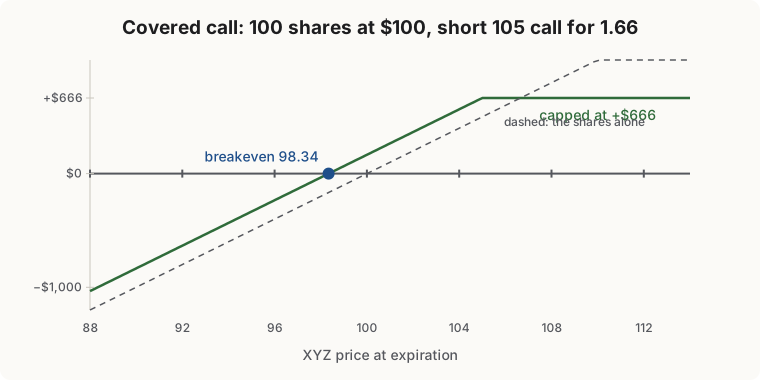
A covered call turns some of the stock’s possible upside into cash now. It suits a stock you are happy to hold that you expect to drift sideways or rise slowly. It is not protection: the $166 cushions only the first $1.66 of a fall.
The cash-secured put
You would like to own XYZ, but at a lower price than $100. Sell one 95 put for 1.33 ($133), and keep $9,500 in cash in the account in case you are assigned.
- If XYZ is above 95 at expiration, the put expires. You keep $133, a return of 133 ÷ 9,367 = 1.42% in 30 days on the money actually at risk.
- If XYZ is below 95, you buy 100 shares at $95. Your real cost is 95 − 1.33 = $93.67, below today’s price.
The covered call and the cash-secured put have the same payoff shape (put-call parity again, Class 3). Both win if the stock stays put or rises, and both carry nearly all the downside of owning the shares.
The wheel combines them: sell cash-secured puts until you are assigned, then sell covered calls on the shares until they are called away, then start again. It is a slow, steady strategy for stocks you genuinely want to own. Its weakness is a stock that falls hard and stays down: you own it all the way down.
Credit spreads: selling with a cap
A credit spread sells one option and buys a further out-of-the-money one of the same type and expiration. You receive money to open it, and the bought option caps the loss.
Bull put spread (bullish to neutral)
Sell the XYZ 95 put at 1.33, buy the XYZ 90 put at 0.40.
Net credit = 1.33 − 0.40 = 0.93 ($93)
- Maximum gain: the credit, $93, if XYZ is at or above 95.
- Maximum loss: width − credit = (95 − 90) − 0.93 = 4.07 ($407), if XYZ is at or below 90.
- Breakeven: short strike − credit = 95 − 0.93 = $94.07.
Bear call spread (bearish to neutral)
Sell the XYZ 105 call at 1.66, buy the XYZ 110 call at 0.66.
Net credit = 1.66 − 0.66 = 1.00 ($100)
- Maximum gain: $100, if XYZ is at or below 105.
- Maximum loss: (110 − 105) − 1.00 = 4.00 ($400), if XYZ is at or above 110.
- Breakeven: short strike + credit = 105 + 1.00 = $106.00.
Look at the risk and reward: you risk about $4 to make $1. That only makes sense because you win far more often than you lose. The short 95 put has a delta of about −0.25, so XYZ finishes above 95 roughly three times in four. Over many trades, the small frequent wins have to outweigh the large occasional losses, and only careful management (below) makes that true.
The iron condor
Put the two credit spreads together on the same expiration: a bull put spread below the market and a bear call spread above it.
| Leg | Price |
|---|---|
| Buy 90 put | −0.40 |
| Sell 95 put | +1.33 |
| Sell 105 call | +1.66 |
| Buy 110 call | −0.66 |
| Net credit | 1.93 ($193) |
- Maximum gain: $193, if XYZ finishes between 95 and 105.
- Maximum loss: width of one side − credit = 5 − 1.93 = 3.07 ($307). Only one side can lose at expiration, because XYZ cannot be below 90 and above 110 at once.
- Breakevens: 95 − 1.93 = $93.07 and 105 + 1.93 = $106.93.
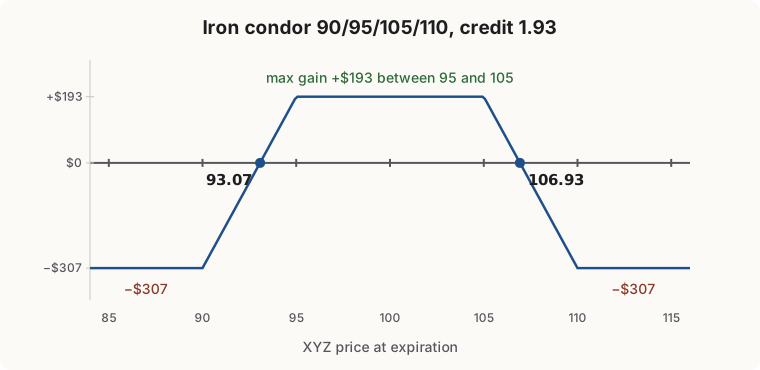
The condor is a bet that XYZ stays in a range until expiration. Compare its breakevens with the expected move from Class 5: one standard deviation was $91.40 to $108.60. The condor’s profit zone, $93.07 to $106.93, sits inside the expected move: the market is paying you $193 to bet that XYZ stays within a narrower range than it expects. Class 10 shows how to place these short strikes at the edges of the Outer Box instead.
Buying power: what selling ties up
Your broker holds back money (buying power or margin requirement) for every short option, to cover the loss.
| Position | Typical requirement |
|---|---|
| Covered call | The shares themselves (nothing extra) |
| Cash-secured put | Strike × 100, less the premium: $9,500 − $133 = $9,367 |
| Credit spread | Width × 100, less the credit: bull put spread $500 − $93 = $407 |
| Iron condor | One side’s width × 100, less the total credit: $500 − $193 = $307 |
| Naked short option | A formula set by your broker, often around 20% of the stock’s value minus the out-of-the-money amount, plus the premium, and much more for volatile stocks |
For defined-risk spreads, the requirement is the maximum loss. That is one reason they are the standard way to sell premium in a small account: you cannot be asked for more than you planned to lose.
Managing short options
Most of a seller’s edge comes from management, not from the entry.
- Take profits early. A common rule is to close when you have captured 50% of the credit. The iron condor’s last $96 can take weeks to collect and carries most of the risk; buying it back early frees the capital and removes the gamma risk.
- Respect the 21-day line. Close or roll positions with about 21 days left. Gamma near expiration (Class 4) makes short options swing hard.
- Have a loss rule. For example, close if the spread’s price reaches twice the credit received, or if the stock closes beyond the short strike. Decide before you enter.
- Rolling. To give a tested position more time, buy back the short option and sell a later one, ideally for a net credit and at a strike further away. Roll only if you would open the new position on its own merits; rolling a loser again and again just postpones and enlarges the loss.
- Watch for assignment. A short option that goes in the money can be assigned early, especially a short call the day before an ex-dividend date (Class 8).
When sellers lose
Short premium does best in calm or range-bound markets with high implied volatility that then falls. It does worst in:
- Sharp trends, where the stock blows through the short strike.
- Gaps on news, which skip past stops.
- Volatility spikes, where IV jumps and every short option gains value at once, even before the stock reaches your strikes.
Keep each position small enough that its maximum loss is an ordinary bad day, not a bad year (Class 9).
2 Check yourself
8 questions. Pass mark 70%. Retake as often as you like; your best score counts.