Buying Options and Debit Spreads
1 Read
Read the class below, including each diagram, then tick the box.
This course is free to read. Sign in to tick off each class, take the quizzes and earn the certificate.
What you will be able to do
- Choose an expiration that gives your idea time to work.
- Choose a strike by what you expect the stock to do, not by what is cheapest.
- Build a bull call spread and a bear put spread, and work out their maximum gain, loss and breakeven.
- Protect shares you own with a protective put or a collar.
- Set exit rules before you enter.
Start with the idea, then the option
Every bought option is a statement about three things. Write them down before you look at the chain:
- Direction: up or down.
- Size: how far. A target price, not “a lot”.
- Time: by when.
If you cannot fill in all three, you are not ready to buy an option. The stock can be bought on direction alone; an option cannot.
Choosing the expiration
Time decay accelerates in the last month (Class 3). So:
- Buy more time than your idea needs. If you expect the move within a month, buy 60 to 90 days. The extra time costs less per day than the time you would otherwise be holding near expiration.
- Plan to sell before the last three weeks. A common rule is to close or roll bought options with about 21 days left, before theta and gamma take over.
- Check the calendar. An earnings date, a dividend or a central-bank meeting inside your expiration raises the price (Class 5). Decide whether you want to own that event.
The 60-day XYZ chain, for comparison with the 30-day one used so far:
| Strike | 95 | 100 | 105 | 110 |
|---|---|---|---|---|
| 60-day call | 8.05 | 5.17 | 3.09 | 1.73 |
| Delta | 0.70 | 0.55 | 0.39 | 0.25 |
The 105 call costs 3.09 for 60 days against 1.66 for 30: twice the time for less than twice the price, with its delta higher (0.39 against 0.31) because more time gives it more chance.
Choosing the strike
The cheapest option is rarely the best. Compare the 30-day calls if you are right about the direction but wrong about the size, and if you are right about both.
| Call | Cost | XYZ at $103 at expiration | XYZ at $108 at expiration |
|---|---|---|---|
| 95 (in the money, delta 0.75) | $665 | +$135 | +$635 |
| 100 (at the money, delta 0.53) | $359 | −$59 | +$441 |
| 105 (out of the money, delta 0.31) | $166 | −$166 | +$134 |
| 110 (far out, delta 0.15) | $66 | −$66 | −$66 |
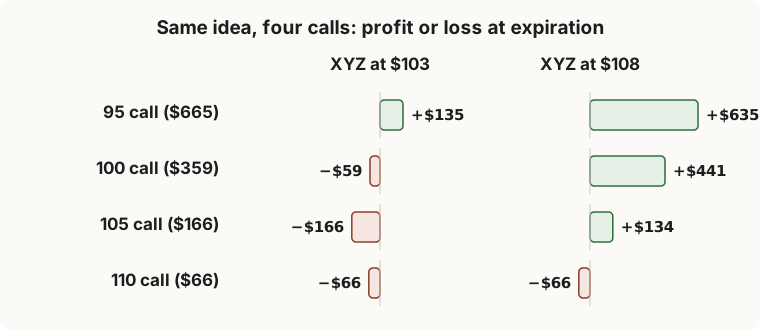
- In the money (delta about 0.70 to 0.80) behaves most like the stock. It costs more, but it makes money on a modest move and loses less time value. Good for a confident direction with an uncertain size.
- At the money (delta about 0.50) has the most time value. A balanced choice when you expect a move about the size of the expected move.
- Out of the money (delta 0.30 or less) is cheap because it needs a big move. Use it only when you expect the stock to travel well past the strike, and size it as a loss you fully expect to take most of the time.
A simple habit: pick the strike your target clears comfortably. If your target is $108, a strike of 100 or below lets the trade pay even if the stock stops short.
The bull call spread
A vertical spread buys one option and sells another of the same type and expiration at a different strike. When you pay to open it, it is a debit spread.
Bull call spread: buy the XYZ 100 call at 3.59, sell the XYZ 105 call at 1.66.
Net debit = 3.59 − 1.66 = 1.93, or $193 a spread.
- Maximum loss: the debit, $193, if XYZ is at or below 100 at expiration.
- Maximum gain: width of the strikes − debit = (105 − 100) − 1.93 = 3.07, or $307, if XYZ is at or above 105.
- Breakeven: lower strike + debit = 100 + 1.93 = $101.93.
- Reward to risk: 307 ÷ 193 = about 1.6 to 1.
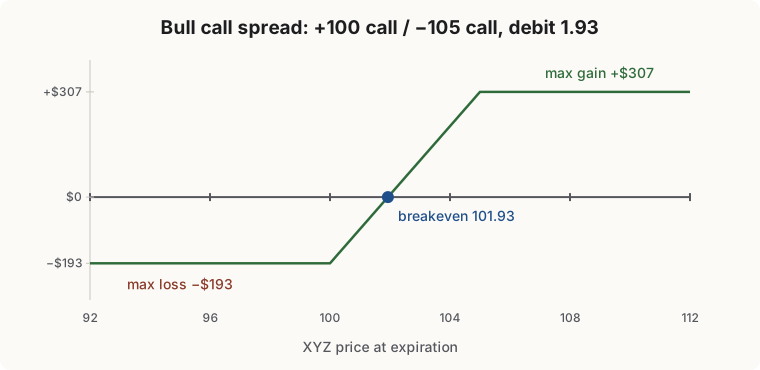
Compare it with buying the 100 call alone for $359. The spread costs 46% less and its breakeven is $101.93 instead of $103.59. In exchange it gives up everything above $105. If your target is about $105 to $108, that is a good trade: you sell the part of the upside you did not expect to reach.
Spreads also soften the two enemies of option buyers:
- Theta: the sold call decays too, offsetting part of the bought call’s decay.
- Vega: a fall in implied volatility hurts the bought call and helps the sold one, so a spread is far less exposed to the volatility crush.
Before expiration, the spread’s value moves less than the full width. With 15 days left, the model values it at 1.73 with XYZ at $100, 2.95 at $104 and 3.99 at $108. That is why most traders take profits on a debit spread when it reaches around 50% to 75% of its maximum value, instead of waiting for the last dollar.
The bear put spread
The same structure, pointing down: buy the XYZ 100 put at 3.26, sell the XYZ 95 put at 1.33.
Net debit = 3.26 − 1.33 = 1.93 ($193)
- Maximum loss: $193, if XYZ is at or above 100.
- Maximum gain: (100 − 95) − 1.93 = 3.07 ($307), if XYZ is at or below 95.
- Breakeven: higher strike − debit = 100 − 1.93 = $98.07.
Use it when you expect a fall to a specific level, the bearish twin of the bull call spread.
Protecting shares: the protective put
You own 100 shares of XYZ at $100 and are worried about the next month, but you do not want to sell. Buy one 95 put for 1.33 ($133).
- Below $95, every dollar the shares lose, the put gains. Your worst case is (100 − 95) + 1.33 = $6.33 a share, or $633, however far XYZ falls.
- Above $95, you keep all of the upside, less the $133 you paid.
It is insurance: you pay a premium for a known floor. Like insurance, it is worth buying before the storm, when it is cheaper, rather than during it, when implied volatility is high.
The collar: insurance paid for by the upside
To cut the cost of the put, sell a call above the market. With 100 shares at $100: buy the 95 put (1.33) and sell the 105 call (1.66).
Net: 1.66 − 1.33 = 0.33 credit ($33 received).
Until November 20, your shares cannot be worth less than $95 or more than $105 to you (if XYZ is above 105 you will likely be assigned and sell at 105). You have traded away the upside above $105 to get the floor at $95 for nothing, and $33 besides. Collars are common for investors with a large gain in one stock who want to lock in most of it.
LEAPS: long-dated options as a stock substitute
LEAPS are options with more than a year to expiration. A deep-in-the-money LEAPS call can stand in for the shares.
XYZ at $100: a one-year 80 call costs about 25.87 ($2,587) with a delta of 0.85.
- It behaves like about 85 shares, for about a quarter of the cost of 100 shares ($10,000).
- Its time value is 25.87 − 20 = 5.87, or about $1.60 a day of decay at first: slow, because it is long-dated and deep in the money.
- The maximum loss is $2,587, against $10,000 for the shares in a collapse, but if XYZ is below $80 in a year the whole $2,587 is gone.
LEAPS let you hold a long-term view with less money tied up. They do not pay dividends, and the leverage cuts both ways.
Exit rules for buyers
Decide all three before you enter, and put them in your plan (Class 9):
- Profit target. For single options, a set percentage (for example +50% to +100%) or the stock reaching your target level. For debit spreads, 50% to 75% of the maximum value.
- Loss limit. For example, close if the option loses half its value, or if the stock closes beyond the level that proves your idea wrong.
- Time stop. Close or roll with about 21 days left, whatever the profit or loss, so you are not holding into the steepest part of the decay curve.
2 Check yourself
7 questions. Pass mark 70%. Retake as often as you like; your best score counts.