How the Stock Market Works
1 Read
Read the class below, including each diagram, then tick the box.
This course is free to read. Sign in to tick off each class, take the quizzes and earn the certificate.
You see stock prices on the news every day. Here is what is actually behind them, in about seven minutes.
New words in this class: share, exchange and broker.
A share is a small piece of a company
A company can divide its ownership into many equal pieces. Each piece is a share, also called a stock. Own some shares and you own that slice of the company.
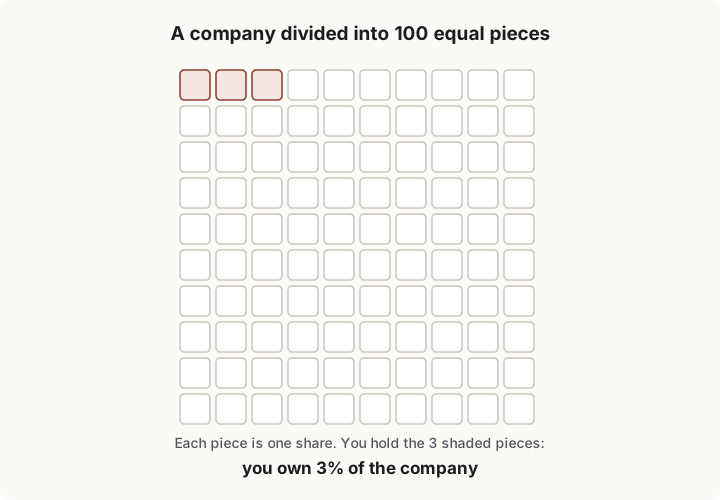
Owning shares means you share in the company’s fortunes. If the company grows and becomes worth more, so do your shares. Some companies also pay out part of their profits to shareholders, called dividends.
Real companies have millions of shares, not 100, but the idea is the same.
Where shares are bought and sold
The first time a company sells shares to the public, the company gets the money; that is how it raises cash to grow. After that, the shares belong to investors, who buy and sell them with each other. That everyday trading is what people mean by “the stock market.”
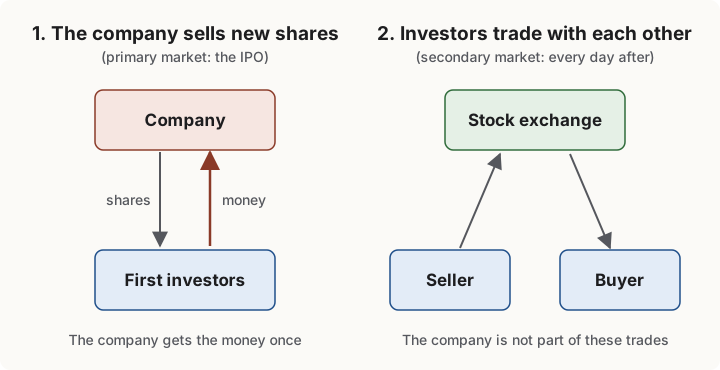
That trading happens on an exchange: a marketplace with strict rules where buy and sell orders meet. In the US, the best known are the New York Stock Exchange and Nasdaq. You can’t walk in yourself; you trade through a broker, the company whose app or website holds your account and sends your orders to the market.
What happens when you click Buy
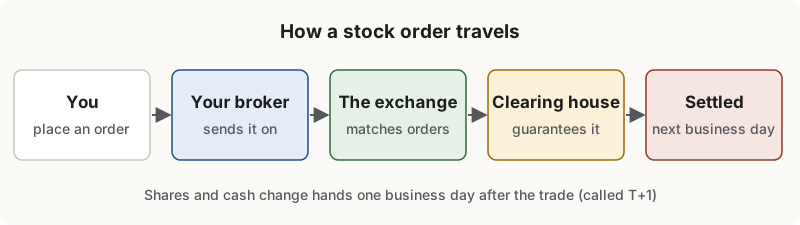
- You choose a stock, how many shares and at what price.
- Your broker checks your account and sends the order on.
- The exchange matches you with a seller, in a split second.
- The shares and the cash swap owners one business day later.
Remember the two prices from First Steps? On an exchange, the bid is the best price any buyer is offering right now and the ask is the best price any seller is asking. Busy stocks have a tiny gap between them; quiet ones have a bigger gap.
What makes the price move
Exactly what you learned in First Steps: the price is the last trade, and it moves when buyers or sellers are keener.
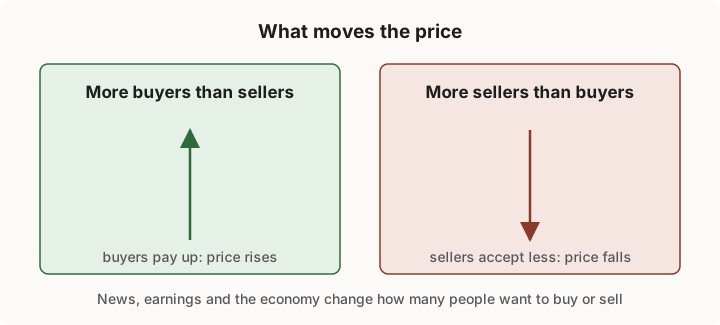
What makes people keener? News about the company, its quarterly results, interest rates and the economy as a whole. Good news brings in buyers; bad news brings out sellers.
When it’s open
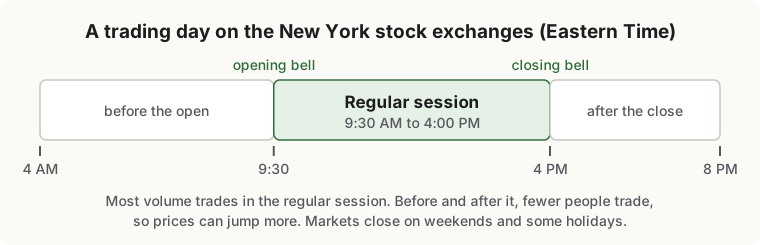
US stock exchanges are open 9:30 AM to 4:00 PM Eastern Time, Monday to Friday, except holidays. Some brokers let you trade a little before and after, but fewer people trade then, so prices can jump more.
Going deeper Who keeps it fair, and “the market was up today”
In the US, the Securities and Exchange Commission (SEC) writes and enforces the rules and makes companies publish honest accounts, and FINRA supervises brokers. When the news says “the market was up,” it usually means an index, a basket of stocks tracked as one number: the S&P 500 (about 500 of the largest US companies), the Dow Jones (30 big names) or the Nasdaq Composite (many technology companies).
Remember
- A share is a small piece of a company.
- Shares are traded between investors on an exchange, through a broker.
- The price moves when buyers or sellers are keener, often because of news.
Where this leads
A stock’s day, week or month can be drawn as one candle, just like in First Steps. The Outer Box method starts right there: the candle’s high and low become the edges of a box. You will see how in Chapter 2: The Candle Is the Box.
2 Check yourself
5 questions. Pass mark 70%. Retake as often as you like; your best score counts.