How the Forex Market Works
1 Read
Read the class below, including each diagram, then tick the box.
This course is free to read. Sign in to tick off each class, take the quizzes and earn the certificate.
If you have ever swapped dollars for euros before a trip, you have already used the forex market. It is the biggest market in the world, and the one the Outer Box book uses for most of its examples.
New words in this class: currency pair, pip and leverage.
Money for money
Forex (short for foreign exchange) is where one country’s money is swapped for another’s. Companies paying overseas suppliers, travellers, investors, central banks and traders all use it. Around $9.6 trillion changes hands every day, and the US dollar is on one side of almost nine trades in ten.
Prices come in pairs
You can’t buy “the euro” on its own: you always buy one currency with another. So forex prices are quoted as a currency pair.
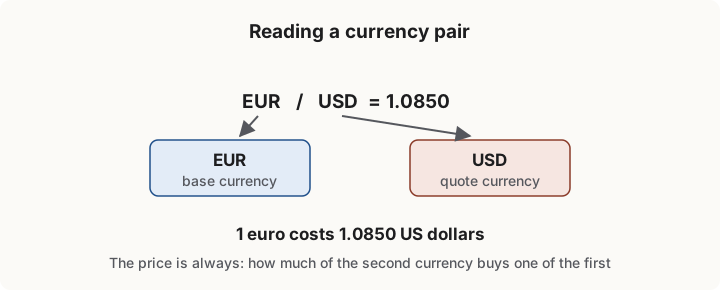
EUR/USD = 1.0850 means one euro costs 1.0850 US dollars. If it rises to 1.0900, the euro has got stronger: one euro now buys more dollars. If it falls, the euro has got weaker.
The most traded pairs all include the US dollar: EUR/USD, USD/JPY, GBP/USD, USD/CHF, AUD/USD, USD/CAD and NZD/USD. Traders call them the majors.
Up or down, both are normal
Every forex trade buys one currency and sells the other at the same moment.
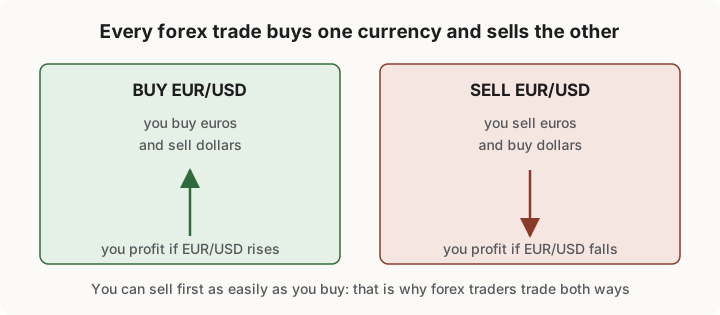
- Buy EUR/USD if you think the euro will get stronger.
- Sell EUR/USD if you think it will get weaker.
Selling first is as ordinary in forex as buying first, so a falling market is as tradable as a rising one.
A market that follows the sun
Forex has no single building or exchange: it is a worldwide network of banks and brokers trading by computer. So instead of one opening bell, trading moves around the globe as each city wakes up: Sydney, Tokyo, London, New York.
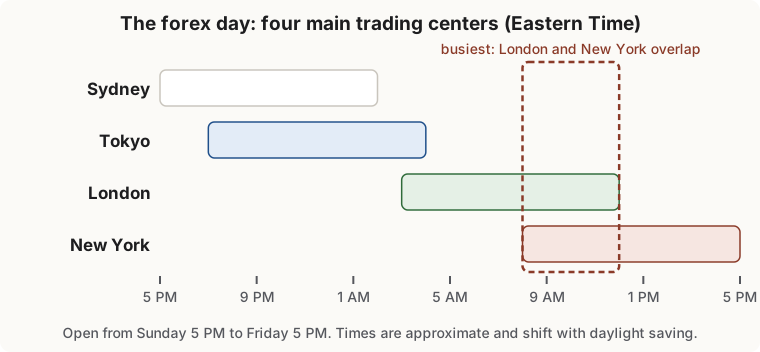
It is open 24 hours a day from about 5 PM Eastern on Sunday to 5 PM Eastern on Friday. The busiest stretch is when London and New York are both open, roughly 8 AM to noon Eastern.
Tiny steps called pips
Exchange rates move in small steps, so traders count in pips.
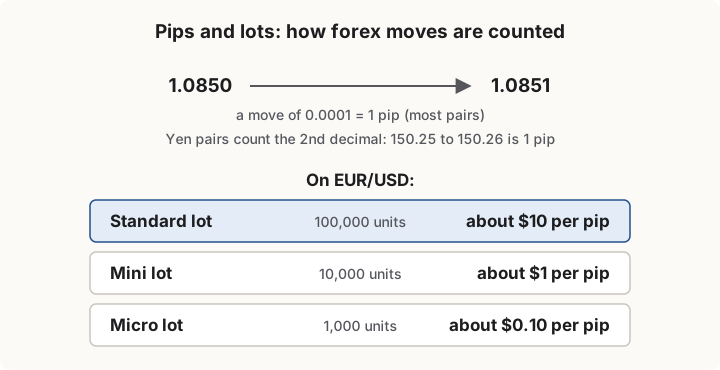
- On most pairs a pip is the fourth decimal: EUR/USD going from 1.0850 to 1.0851 is one pip.
- On yen pairs it is the second decimal: 150.00 to 150.01 is one pip.
How much a pip is worth in money depends on how big your trade is; you will work that out in Forex Essentials. For now: on the smallest common trade size, a pip on EUR/USD is worth about 10 cents.
Leverage: handle with care
Forex brokers let you control a large amount of currency with a small deposit. That is leverage, and it works like a magnifying glass: it makes gains and losses bigger.
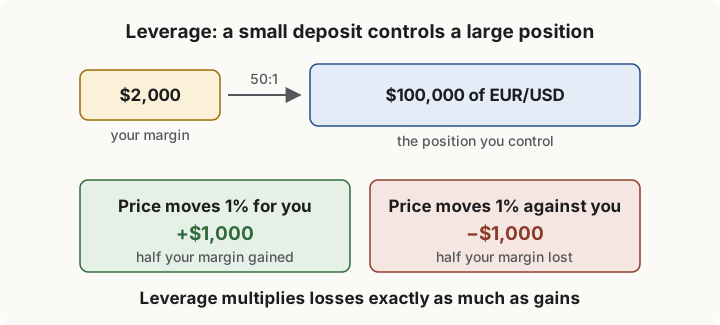
At 50 to 1, $2,000 controls $100,000. Then a 1% move is $1,000, half your deposit, in either direction. That is why beginners start with the smallest sizes and learn to manage risk first (that’s Risk and Money Management, two courses from now).
Going deeper Who keeps forex fair in the US
The Commodity Futures Trading Commission (CFTC) regulates forex, and the National Futures Association (NFA) registers and supervises forex brokers. US rules cap leverage for individual traders at 50 to 1 on the major pairs and 20 to 1 on the others. Before opening an account with a US broker, check it is registered with the NFA; other countries have their own regulators.
Remember
- Forex prices come as a currency pair: EUR/USD is how many dollars one euro costs.
- It trades around the clock on weekdays, busiest when London and New York overlap.
- Prices move in pips, and leverage makes every pip count for more, both ways.
2 Check yourself
5 questions. Pass mark 70%. Retake as often as you like; your best score counts.