Stocks and Forex, Side by Side
1 Read
Read the class below, including each diagram, then tick the box.
This course is free to read. Sign in to tick off each class, take the quizzes and earn the certificate.
You’ve seen both markets. Now let’s put them next to each other, like comparing two cars before a road trip: both get you there, but they handle differently.
New words in this class: liquidity and slippage.
What you’re actually trading
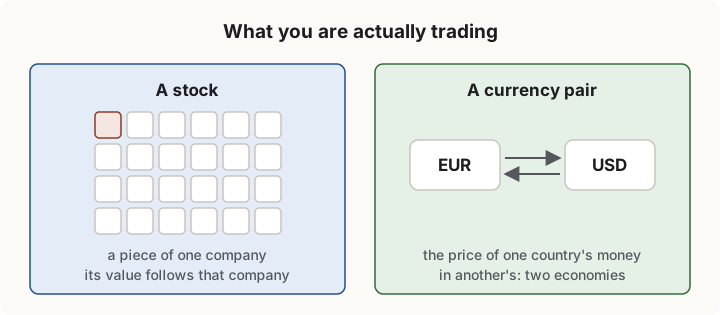
- A stock is a piece of one company. Its price follows that company: its sales, its profits, its news.
- A currency pair is the price of one country’s money in another’s. It follows two whole economies: their interest rates, their growth, their central banks.
The differences at a glance
| Stocks (US) | Forex | |
|---|---|---|
| What you trade | A piece of a company | One currency’s price in another |
| Hours | 9:30 AM to 4 PM Eastern, weekdays | Around the clock, Sunday evening to Friday evening |
| How many to choose from | Thousands of companies | Seven major pairs, plus others |
| Selling first | Possible, with extra steps | As normal as buying |
| Leverage for individuals (US) | Up to about 2 to 1 | Up to 50 to 1 on the majors |
| Smallest trade | One share, or part of one | A micro lot: 1,000 units of currency |
| What moves it | Company news and results | Interest rates, economic reports, central banks |
Busy markets are easier markets
Liquidity means how easily you can buy or sell, quickly, at a fair price. A liquid market is like a busy shop: lots of buyers and sellers at every moment, so you’re never stuck waiting.
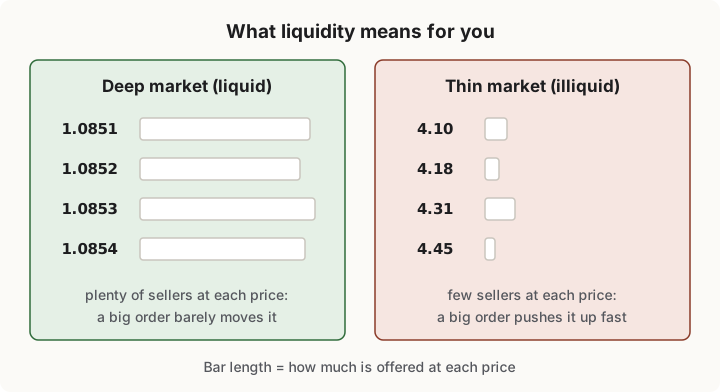
Why it matters to you:
- Cheaper trades: the gap between the two prices (the spread) is small.
- Fairer fills: your order fills at or near the price you saw. Getting a worse price because the market moved while your order filled is called slippage, and busy markets have less of it.
- Easy exits: you can get out when you want.
By daily trading, forex is the biggest market in the world, about $9.6 trillion a day against about $1.1 trillion for US stocks. But that busyness isn’t spread evenly: it is mostly in the major pairs, above all EUR/USD, during the main hours. The simple rule for both markets: trade what’s busy, when it’s busy.
Why many new traders start with forex
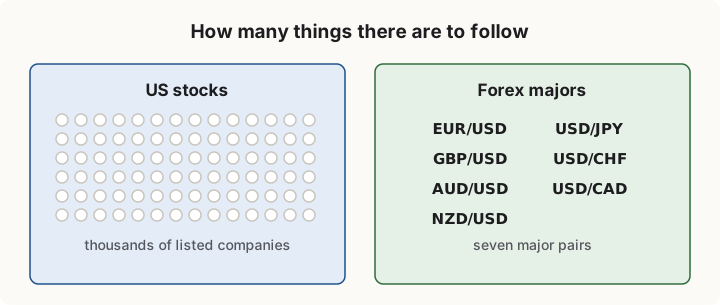
- A short list to learn: seven major pairs instead of thousands of companies.
- Hours that fit your life: before work, after work or late at night.
- Both directions are normal: a falling market is as tradable as a rising one.
- Start tiny: micro lots let you learn while risking cents.
- Scheduled news: the big market movers are published on a calendar in advance.
- Same chart reading: a pair’s day, week and month are boxes just like a stock’s, so the Outer Box works unchanged.
What to respect before you begin
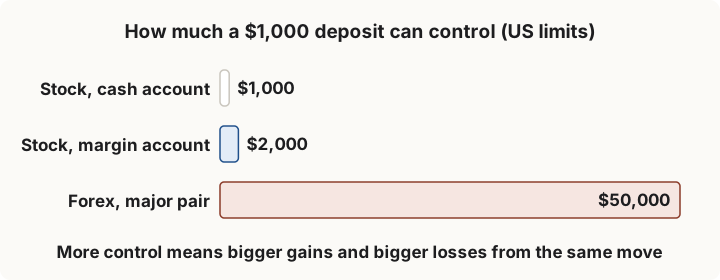
- Leverage cuts both ways. At 50 to 1, a 2% move against you can wipe out the whole deposit. Trade small.
- Pick a regulated broker. In the US, check it is registered with the NFA.
- Around the clock means around the clock. Prices move while you sleep, and can jump between Friday’s close and Sunday’s open.
- Many beginners lose money. That’s why every broker shows a risk warning. A method, a plan and small size come first.
None of that is meant to scare you off. It’s the seatbelt talk before the drive, and the next two courses are the seatbelt.
Remember
- A stock follows one company; a currency pair follows two economies.
- Liquidity means busy and easy to trade; quiet markets bring wider spreads and more slippage.
- Forex’s long hours, short list and small sizes suit beginners, as long as leverage is respected.
2 Check yourself
5 questions. Pass mark 70%. Retake as often as you like; your best score counts.