Why Good Rules Get Broken
1 Read
Read the class below, including each diagram, then tick the box.
This course is free to read. Sign in to tick off each class, take the quizzes and earn the certificate.
The plan is easy; the moment is hard
Almost every trader who loses money had a plan that said what to do. The plan was broken in the moment: the stop moved, the size doubled, the trade taken that the rules said to skip. Those moments follow a few well-known patterns. Knowing them by name makes them easier to spot.
Losses hurt more than gains please
Research by the psychologists Daniel Kahneman and Amos Tversky found that people feel a loss much more strongly than a gain of the same size; in many studies, roughly twice as strongly. This is called loss aversion.
In trading, it shows up in two ways:
- Moving the stop away. Taking the loss makes it real, so the stop is moved “just a little further”. The trade that should have cost 1R costs 3R.
- Not taking the trade at all after a loss, even when the setup is exactly right, because another loss would hurt.
Cutting winners, holding losers
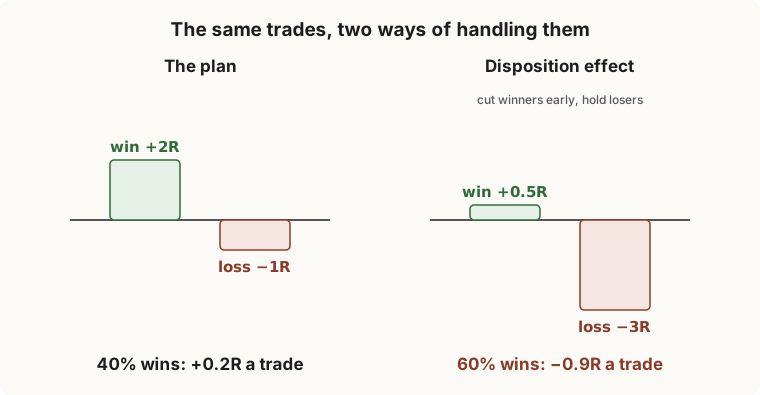
Investors show a strong tendency to sell winners too early and hold losers too long, known as the disposition effect. A small gain feels good to lock in; a loss feels better left open, in case it comes back.
The result is the worst of both: small wins and large losses. That is the opposite of the reward-to-risk that a method like the Outer Box is built on, where the target is the next level and the stop is where the reading fails.
Fear of missing out
Price is running without you. Every bar makes the missed move bigger. You chase it, entering late, far from any level, with a stop that makes no sense. FOMO turns a missed trade, which costs nothing, into a bad trade, which costs money.
The ladder helps: if price is already far from the level where the setup was, the trade is gone. The next one will come at the next level.
Revenge trading
After a loss, especially an unfair-feeling one, there is a strong urge to win it back now: a bigger trade, a worse setup, right away. A trader who loses 1R and then takes a revenge trade at three times the size can turn a normal day into the worst week of the year.
Overtrading
Taking trades because you are at the screen, not because a setup has formed. Boredom, the wish to be doing something, and the belief that more trades mean more profit all push the same way. A well-known study of tens of thousands of brokerage accounts by Brad Barber and Terrance Odean found that the investors who traded most earned the least, after costs.
The Outer Box has a built-in defence: between box closes, the levels do not move (Chapter 19). If no level has been reached and no trigger has fired, there is nothing to do.
The one defence: decide before
Every pattern above is a decision made during a trade, under pressure. The defence is the same for all of them: make the decisions before, when nothing is at stake, and write them down.
- The stop is set when the trade is opened, and only ever moves in the trade’s favour.
- The size comes from the risk rule, not from how the last trade went.
- The daily loss limit ends the day; it is not renegotiated.
- No level, no trigger, no trade.
The next three classes are about making those decisions automatic.
Exercise
Look back at your last ten trades, real or practice. For each one, note whether any of these five patterns played a part. Most traders find one or two that keep coming back. Those are the ones your rules should guard most closely.
2 Check yourself
6 questions. Pass mark 70%. Retake as often as you like; your best score counts.