Routines and the Pre-Trade Checklist
1 Read
Read the class below, including each diagram, then tick the box.
This course is free to read. Sign in to tick off each class, take the quizzes and earn the certificate.
Routines make decisions for you
Pilots use checklists not because they forget how to fly, but because a checklist catches the one step that gets skipped when they are tired, rushed or distracted. Trading is the same. A routine turns your plan into steps you follow without having to argue with yourself each time.
Work at the closes
The Outer Box gives your routine a natural rhythm: the levels change only when a box closes (Chapter 19, step 8).
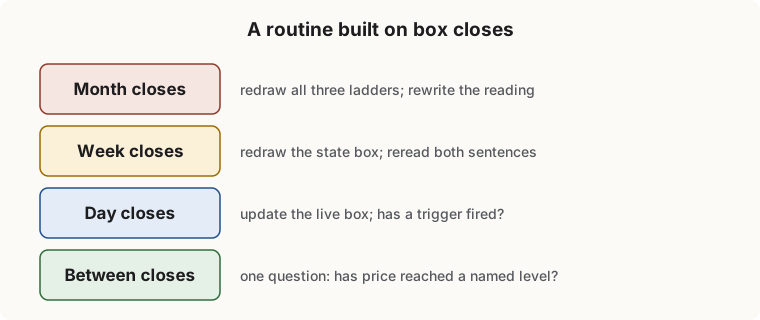
- When the direction box closes (for example, the month): redraw all three ladders and rewrite your reading.
- When the state box closes (the week): redraw it and reread your reading and its invalidation.
- At each trading-box close (the day, or the hour for a day trader): update, then decide whether a trigger has fired.
- Between closes: one question only. Has price reached a level I named? If not, close the chart.
This keeps your screen time short and purposeful. Most of what happens between closes is noise that the levels have already accounted for.
The pre-trade checklist
Before any order, every line must be a yes. If one is a no, there is no trade.
| # | Check | Yes / No |
|---|---|---|
| 1 | I have written the reading in one sentence: direction, state, what I expect | |
| 2 | I have written the level that would prove it wrong | |
| 3 | The trade is in the direction the outer box’s C allows (or it is a planned counter-trend trade at reduced size) | |
| 4 | Price is at a named level, and the trigger has fired on a closed bar | |
| 5 | My stop is beyond the threshold, at the level in check 2 | |
| 6 | My target is the next ladder level | |
| 7 | My size comes from my risk rule and this stop distance | |
| 8 | This trade keeps me inside my total-risk limit | |
| 9 | I am not inside my daily loss limit, and no high-impact news is due that I have not planned for | |
| 10 | I would take this trade if my last trade had been a win |
Check 10 is the one that catches revenge trades and fear after a loss. If the answer depends on how the last trade went, it is not a setup; it is a feeling.
Set your session
Decide in advance when you trade, and stick to it:
- the hours you look at charts (for example, the London–New York overlap, or once at the daily close);
- the pairs you follow (a short list you know well, rather than every market that moves);
- what ends the session: a time, a number of trades, or your daily loss limit.
A fixed session protects you from the late-night trade taken out of boredom or frustration.
Look after the trader
Decisions get worse when you are tired, hungry, angry or distracted. Many traders add one line to their routine: if I am not in a state to follow the checklist calmly, I do not trade today. Missing a day costs nothing. Most bad weeks start with one trade taken in the wrong state of mind.
Exercise
Copy the checklist. For the next five trades, real or practice, tick every line before you place the order, and keep the sheet. If you find yourself skipping a line, note which one. That is where your plan is weakest.
2 Check yourself
6 questions. Pass mark 70%. Retake as often as you like; your best score counts.