Keeping a Journal That Teaches You Something
1 Read
Read the class below, including each diagram, then tick the box.
This course is free to read. Sign in to tick off each class, take the quizzes and earn the certificate.
Memory is a bad record
After a few weeks, most traders remember their trades the way they wish they had gone: the winners they called, not the stops they moved. A journal replaces memory with a record, and a record is the only way to find out what is actually working.
Write before, then after
The most useful journal entries have two halves.
Before the trade (this is the reading, and it takes a minute):
- the pair and the three boxes;
- the reading in one sentence, and the level that would change it (Chapter 19, steps 6 and 7);
- entry, stop, target and size, each as a ladder level;
- your state: calm, rushed, tired, frustrated?
After the trade:
- the result in R (how many times your risk you made or lost);
- whether you followed the plan, line by line;
- one sentence: what happened at the levels, and was the reading right?
If you have the site’s Ladder tool, a saved reading with its two-sentence note is the “before” half. Add the result when the trade closes, and the record builds itself.
Grade the decision, not the result
A trade can follow every rule and lose. Another can break every rule and win. If you judge trades only by the result, you will learn the wrong lessons: that breaking the rules works.
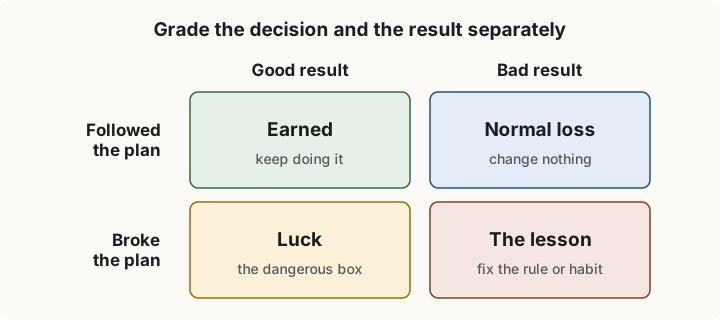
| Good result | Bad result | |
|---|---|---|
| Followed the plan | Earned | A normal loss. Change nothing |
| Broke the plan | Luck. The most dangerous box, because it teaches you to break the plan again | The lesson. Find which rule broke and why |
Score each trade on a simple scale: followed the plan: yes, partly or no. Over time, the share of “yes” trades is one of the best measures of your progress as a trader, and it is entirely in your control.
The weekly review
Once a week, at a fixed time, read the week’s entries and answer five questions:
- How many trades, and what was the total result in R?
- What share of trades followed the plan?
- Which rule was broken most often?
- Were the readings right, even on the trades that lost?
- What is one thing to do differently next week?
Only one. A review that produces ten changes produces none.
Let the numbers decide
After 50 to 100 trades, the journal can answer questions that feelings cannot:
- Your expectancy in R, overall and by setup (pullback, trend, failed rejection, counter-trend).
- Which pairs and which hours work for you, and which do not.
- Whether trades taken while tired or frustrated do worse than the rest. They usually do.
Those answers become changes to your plan, made calmly between trades, which is exactly where plan changes belong.
Exercise
Start a journal today, in a notebook, a spreadsheet or the Ladder tool. For your next ten trades, real or practice, write the before half before you place the order. At the end of the week, do the five-question review.
2 Check yourself
6 questions. Pass mark 70%. Retake as often as you like; your best score counts.